

A common Order-in-Original (OIO) may involve multiple taxpayers or noticees in a DGGI investigation.
But when the Department decides to challenge the Order-in-Appeal (OIA) before the GST Appellate Tribunal (GSTAT), several practical questions arise:
Who reviews the appellate order?
Who files the appeal?
And which GSTAT Bench has jurisdiction?
The CBIC has now provided procedural clarity on these issues in cases where the original order was passed by a Common Adjudicating Authority (CAA) in DGGI matters.
The Procedural Issue
Where a CAA passes an OIO involving multiple taxpayers, the subsequent appellate proceedings may involve taxpayers falling under different jurisdictional Commissionerates.
This raises an important question:
Should the Department file one common appeal before the GSTAT Bench having jurisdiction over the CAA?
The CBIC Circular clarifies that the answer is no.
What Does the Circular Clarify?
1. The CAA-jurisdiction Commissionerate examines the Order-in-Appeal
The Principal Commissioner/Commissioner having jurisdiction over the CAA is responsible for examining the Order-in-Appeal.
Where necessary, inputs may be obtained from the DGGI, and the relevant comments/recommendations are to be communicated to the jurisdictional Commissionerates of the respective taxpayers/noticees.
2. The respective jurisdictional Commissioner acts as the Reviewing Authority
The Principal Commissioner/Commissioner having jurisdiction over the respective taxpayer/noticee will act as the Reviewing Authority under Section 112(3).
Therefore, the fact that the original adjudication was undertaken by a CAA does not transfer the review responsibility to the CAA’s jurisdictional Commissionerate.
3. Separate departmental appeals are to be filed
Where the Order-in-Appeal concerns multiple taxpayers/noticees, separate departmental appeals are to be filed for each taxpayer/noticee.
The respective jurisdictional CGST Commissionerate will undertake the filing and further prosecution of the appeal.
4. Which GSTAT Bench has jurisdiction?
This is perhaps the most important clarification.
The departmental appeal is to be filed before the GSTAT Bench having territorial jurisdiction over the respective taxpayer/noticee.
It is not to be filed before the GSTAT Bench having jurisdiction over the Commissionerate of the Common Adjudicating Authority merely because the CAA passed the original order.
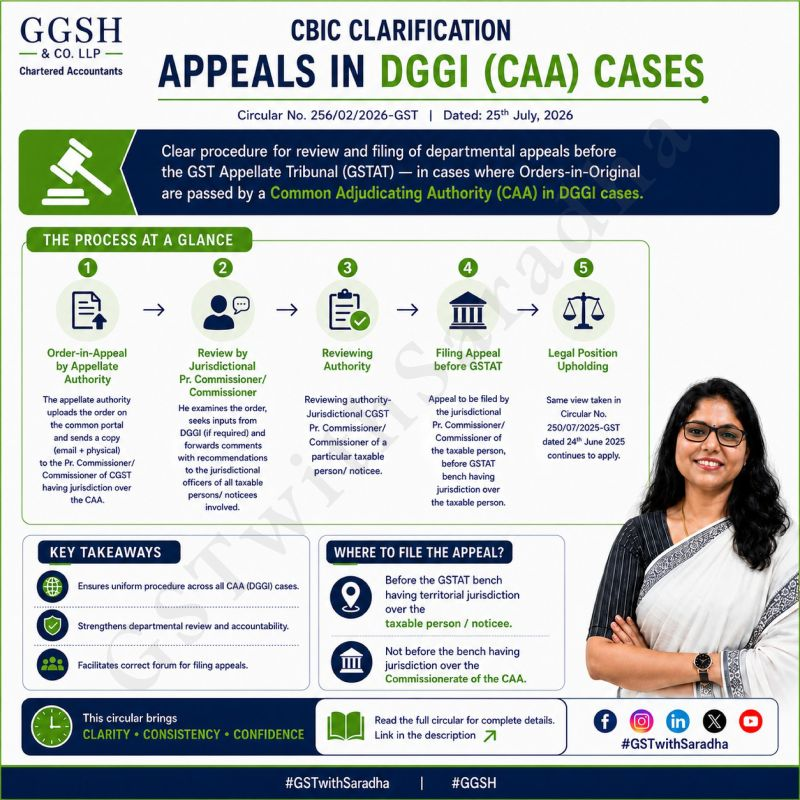
The Process at a Glance
Order-in-Appeal
↓
Examination by Commissionerate having jurisdiction over the CAA
↓
Comments / recommendations shared with the respective jurisdictional Commissionerates
↓
Jurisdictional Commissioner of each taxpayer acts as Reviewing Authority
↓
Separate departmental appeal for each taxpayer/noticee
↓
Appeal filed before the GSTAT Bench having territorial jurisdiction over that taxpayer/noticee
Why Is This Important?
At first glance, this may appear to be a procedural clarification.
In practice, however, it provides an important framework for handling departmental appeals arising from DGGI cases involving a Common Adjudicating Authority.
The correct forum cannot simply be determined by looking at where the CAA is located.
The territorial jurisdiction of the respective taxpayer/noticee becomes relevant when determining the appropriate GSTAT Bench.
This can be particularly important where a single common adjudication involves taxpayers located across different jurisdictions.
The Larger Significance
The Circular does not alter the substantive merits of the underlying tax dispute.
Instead, it brings clarity to the review, filing and forum-selection process for departmental appeals in these CAA cases.
In tax litigation, procedural clarity matters. A correct legal position must also reach the right authority, through the right procedure, before the right forum.
Key Takeaway
A common adjudication does not necessarily result in a common appellate process.
For DGGI cases involving a Common Adjudicating Authority:
Reviewing Authority → Jurisdictional Commissioner of the respective taxpayer/noticee
Appeal → Separate appeal for each taxpayer/noticee
Filing Authority → Respective jurisdictional CGST Commissionerate
GSTAT Forum → Bench having territorial jurisdiction over the respective taxpayer/noticee
Not → GSTAT Bench having jurisdiction over the CAA’s Commissionerate
The Circular therefore brings much-needed clarity to an important procedural question in departmental GST litigation.
Source: CBIC Circular No. 256/02/2026-GST dated 25 July 2026.
