

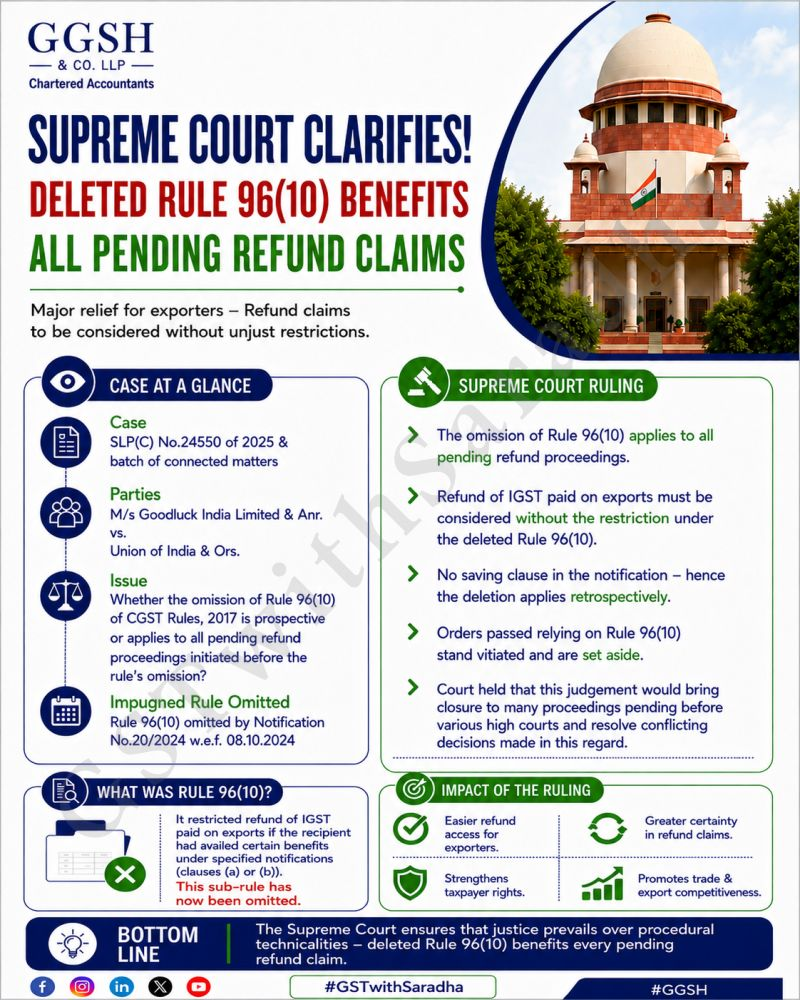
For exporters, disputes relating to Rule 96(10) of the CGST Rules have remained a significant source of uncertainty, particularly where IGST refunds were withheld or rejected on the ground of alleged non-compliance with the provision.
The Supreme Court’s recent decision in M/s Goodluck India Limited & Anr. v. Union of India & Ors. provides important clarity on the legal consequences of the subsequent omission of Rule 96(10).
The Background: Rule 96(10) and IGST Refunds
Rule 96(10) had placed restrictions on the availability of refund of IGST paid on exports in specified circumstances, particularly where the exporter had availed certain specified benefits relating to procurement or input taxes.
Over time, disputes arose regarding the validity, applicability and continuing effect of the provision.
A particularly important question was:
What happens to proceedings that were still pending when Rule 96(10) was omitted?
This question became significant for exporters whose refund claims, adjudications, appeals or writ proceedings continued even after the provision ceased to exist.
The Omission of Rule 96(10)
Rule 96(10) was omitted with effect from 8 October 2024.
The significance of the amendment was not limited to future transactions.
The question was whether the omitted provision could continue to be relied upon by the Department in proceedings that were still pending as on the date of omission.
In Goodluck India Limited, the Supreme Court considered this issue in the context of pending proceedings concerning IGST refunds.
The Supreme Court’s Decision
In M/s Goodluck India Limited & Anr. v. Union of India & Ors., SLP(C) No. 24550/2025 and connected matters, the Supreme Court dismissed the appeals filed by the Union of India on 6 August 2026.
The decision upheld the view that the omission of Rule 96(10), effective from 8 October 2024, has consequences for proceedings that remained pending on that date.
A significant aspect of the reasoning concerns the legal effect of omitting a statutory provision without a saving clause.
Why the Absence of a Saving Clause Matters
When a statutory provision is removed, an important question arises:
Can the omitted provision continue to govern pending proceedings?
The Supreme Court’s approach draws upon the Constitution Bench decision in Kolhapur Canesugar Works Ltd. v. Union of India, which examined the legal consequences of repeal or omission of statutory provisions in the absence of a saving clause.
Where an existing provision is omitted without a saving provision preserving its operation for pending matters, the omitted provision cannot simply continue to be treated as though it remains part of the law.
This principle became particularly relevant to Rule 96(10).
Once the provision was omitted, its continued use as a basis for restricting refund claims in pending matters had to be examined in light of the legal effect of that omission.
What Could This Mean for Pending Refund Matters?
The decision can have practical significance in cases where Rule 96(10) was relied upon as the basis for withholding or rejecting an export refund.
Potentially relevant matters may include:
1. Refunds Withheld or Rejected on Rule 96(10) Grounds
Where a refund was denied specifically because of alleged contravention of Rule 96(10), the order may require fresh examination in light of the Supreme Court’s decision.
2. Pending Adjudication Proceedings
Where the alleged contravention of Rule 96(10) remains the principal or sole basis of the proceedings, the subsequent omission of the provision may have a direct bearing on the matter.
3. Pending Appeals and Writ Proceedings
Cases that were pending when Rule 96(10) was omitted may need to be reviewed to determine the impact of the Supreme Court’s ruling.
4. Existing Orders Based on Rule 96(10)
Where an earlier order has relied upon Rule 96(10), taxpayers may need to examine whether consequential relief or further legal action is available in light of the subsequent judicial development.
What the Judgment Does Not Mean
The decision should not be understood as creating an automatic refund entitlement for every exporter who was previously affected by Rule 96(10).
The omission of Rule 96(10) does not remove the other statutory requirements applicable to refund claims.
Exporters must still satisfy the relevant provisions governing refund eligibility and establish compliance with other applicable conditions.
Therefore, the correct approach is not:
“Rule 96(10) is gone, so every refund must now be granted.”
Rather, the question is:
“Was the refund withheld or rejected specifically because of Rule 96(10), and what is the effect of its omission on that pending matter?”
That distinction is important.
What Should Exporters Do Now?
Businesses with old or pending refund disputes should consider reviewing their files systematically.
Step 1: Identify Pending Refund Matters
Prepare a list of refunds that remain:
- Withheld;
- Rejected;
- Under adjudication;
- Under appeal; or
- Under writ proceedings.
Step 2: Check Whether Rule 96(10) Was Relied Upon
Review the relevant:
- Refund rejection orders;
- Show Cause Notices;
- Adjudication orders;
- Appeal orders; and
- Correspondence with the Department.
Identify whether Rule 96(10) was the sole or principal ground for the adverse action.
Step 3: Review the Export Documentation
Even where Rule 96(10) is no longer available as a ground, other refund requirements continue to matter.
Therefore, exporters should reconcile and verify:
- Export invoices;
- Shipping bills;
- Bills of lading or airway bills;
- GST returns;
- Payment realisation records;
- Relevant refund applications; and
- Other supporting documents.
Step 4: Examine Consequential Relief
Where an existing order was based on Rule 96(10), the taxpayer should examine the appropriate legal mechanism for seeking consequential relief in light of the Supreme Court’s ruling.
The Larger Lesson
The Goodluck India decision demonstrates that an amendment or omission to tax legislation can have consequences that extend beyond the date on which the change comes into force.
For businesses, the legal effect of an amendment must therefore be examined not only prospectively but also in relation to pending proceedings and existing disputes.
For exporters who have been waiting for years for their IGST refunds, this may be an important opportunity to revisit matters that were previously considered blocked by Rule 96(10).
The practical message is simple:
If Rule 96(10) was the reason your refund was withheld, rejected or disputed, the matter may deserve a fresh review in light of the Supreme Court’s decision.
The omission of a provision can sometimes change not only what businesses must do going forward, but also how yesterday’s pending disputes need to be viewed today.
Case Reference
M/s Goodluck India Limited & Anr. v. Union of India & Ors.
SLP(C) No. 24550/2025 & connected matters
Supreme Court of India
Decision: 6 August 2026
Relevant precedent: Kolhapur Canesugar Works Ltd. v. Union of India
