

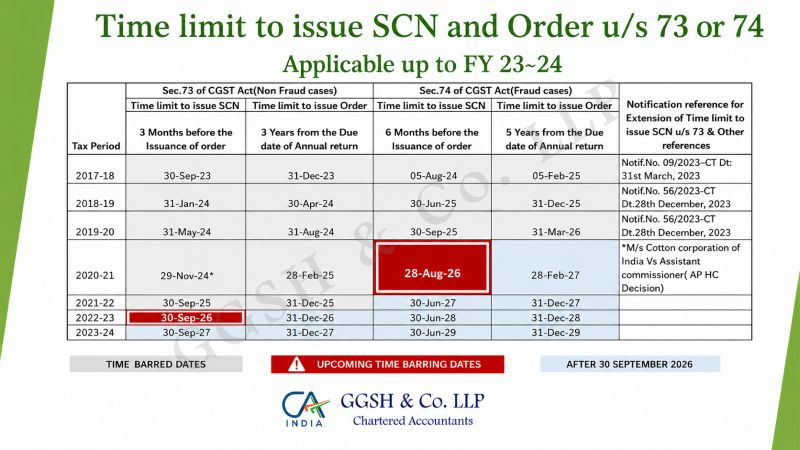
As important GST time limits for issuing Show Cause Notices (SCNs) approach, taxpayers need to be particularly careful about monitoring their GST communications.
A Show Cause Notice can have significant consequences for a business. However, the issue does not end with whether a notice has been issued. How the notice is communicated and whether it has been properly served can also become important in subsequent proceedings.
Why the Upcoming Deadlines Matter
GST law prescribes specific time limits within which the Department must issue proceedings for tax not paid, short paid, or input tax credit wrongly availed or utilised, depending on the applicable provision and circumstances.
With certain financial years approaching their relevant limitation periods, taxpayers should review their GST records and remain alert to communications from the Department.
Key Upcoming Time-Barring Dates
| Financial Year | Provision | Last Date for Issuance of SCN |
|---|---|---|
| FY 2020–21 | Section 74 | 28 August 2026 |
| FY 2022–23 | Section 73 | 30 September 2026 |
These dates make it particularly important for businesses to monitor their GST compliance position and communications during this period.
How Can a GST Notice Be Communicated?
Section 169 of the CGST Act provides for the methods through which decisions, orders, summons, notices and other communications under the Act may be served.
Depending on the circumstances and applicable mode, communication may involve:
- Electronic communication, including email;
- Registered or speed post;
- Courier;
- Direct delivery;
- Publication in accordance with the prescribed provisions; and
- Other prescribed modes.
Therefore, businesses should not rely solely on physical correspondence reaching their office.
GST portal communications and registered email channels should also be monitored regularly.
Why Missing a Notice Can Be Serious
A taxpayer may miss a notice for several practical reasons:
- The registered email account may not be monitored regularly.
- GST portal communications may remain unnoticed.
- The authorised signatory may have changed.
- Internal responsibility for GST compliance may be unclear.
- Physical correspondence may reach the wrong department or remain unattended.
However, failing to notice a communication can have serious consequences if the proceedings continue without an appropriate response.
A taxpayer may lose the opportunity to:
- Submit a detailed reply;
- Produce supporting documents;
- Explain the transaction;
- Challenge the allegations;
- Attend a personal hearing; or
- Raise appropriate legal and factual objections.
Time-Barring Is Not Just a Date on the Calendar
The approaching limitation dates are relevant not merely because a particular date is approaching.
Businesses should understand the broader timeline surrounding a potential GST dispute.
This includes examining:
What is the relevant financial year?
Which statutory provision applies?
What is the prescribed limitation period?
When was the relevant notice required to be issued?
How was the notice communicated or served?
Was the taxpayer given the appropriate opportunity to respond?
These questions can become important when the validity of GST proceedings is subsequently examined.
What Should Businesses Do Now?
1. Monitor the GST Portal
Regularly check the GST portal for notices, orders, communications and other pending actions.
2. Monitor Registered Email
Ensure that the email address registered with the GST authorities is actively monitored.
3. Verify Authorised Signatory Details
Changes in personnel should not result in GST communications being overlooked.
4. Review Pending GST Matters
Businesses should identify outstanding notices, assessments, audit proceedings and other departmental communications relating to earlier financial years.
5. Maintain a Compliance Calendar
Track important statutory deadlines and limitation dates for each financial year.
6. Preserve Evidence of Communications
Maintain copies of notices, orders, acknowledgements, emails and other relevant communications. Proper records can become important if a dispute later arises regarding service or limitation.
The Practical Takeaway
As the relevant time-barring dates approach, GST communication monitoring should become a priority for businesses.
A taxpayer should not wait until an assessment or demand reaches the final stage to discover that a notice was issued earlier.
The safest approach is simple:
WATCH → TRACK → RESPOND
Watch the GST portal.
Track communications through the prescribed modes.
Respond within the applicable timelines.
Because in GST litigation, missing the communication can sometimes be just as consequential as missing the deadline.
Important Dates
FY 2020–21 — Section 74
28 August 2026
FY 2022–23 — Section 73
30 September 2026
Businesses should review their individual facts and the applicable statutory provisions before relying on any limitation date.
