

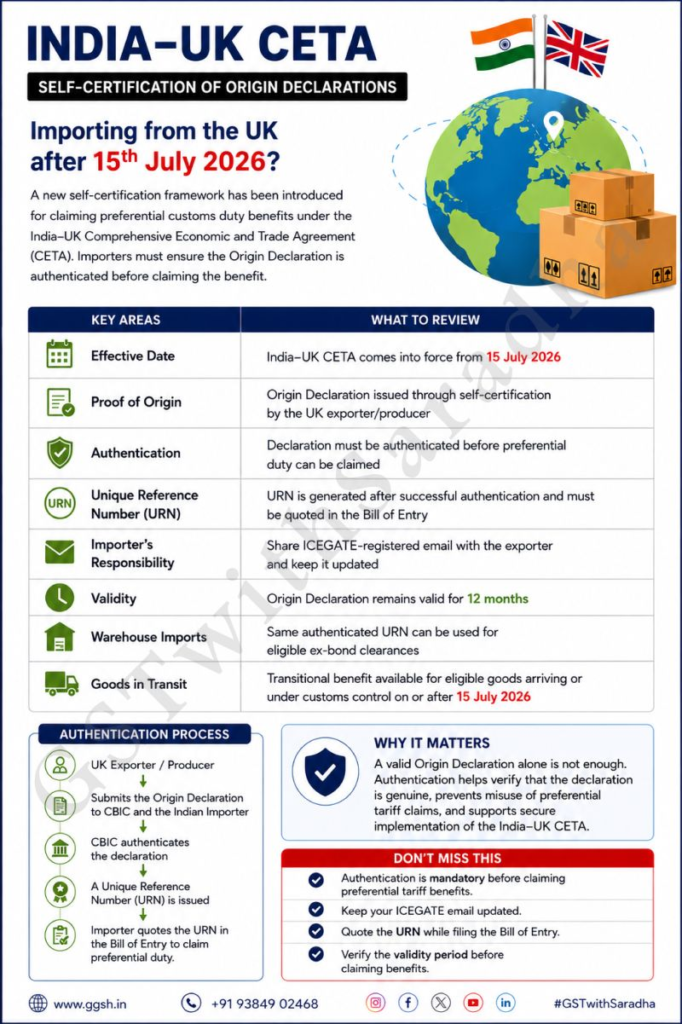
Preferential tariff treatment can make imports more cost-effective. But when importing eligible goods from the UK under the India–UK Comprehensive Economic and Trade Agreement (CETA), possessing an Origin Declaration alone may not be sufficient.
With CETA coming into force on 15 July 2026, a new Self-Certification Framework has been introduced for claiming preferential tariff treatment on eligible imports from the UK.
The key change is an additional layer of authentication.
How the New Process Works
Under the framework, a UK exporter or producer can self-certify the origin of the goods. However, the process does not end with the declaration.
The sequence broadly works as follows:
Origin Declaration → Authentication → URN Generation → Preferential Tariff Claim
The Origin Declaration must be submitted through the prescribed process. Indian Customs then authenticates the declaration against the information shared by UK Customs.
Once authentication is successfully completed, a Unique Reference Number (URN) is generated. The importer must then quote this URN in the relevant Bill of Entry while claiming the preferential tariff benefit.
Therefore, the approach should not simply be:
“I have the Origin Declaration, so I am done.”
The declaration is only one part of the process.
Practical Checklist for Importers
Businesses importing goods from the UK should consider the following:
- Keep the ICEGATE-registered email address updated and ensure it is shared with the UK exporter.
- Ensure proper authentication of the Origin Declaration before claiming preferential treatment.
- Quote the URN in the relevant Bill of Entry.
- Track the 12-month validity of the Origin Declaration.
- Review whether goods already in transit or under Customs control when CETA came into force qualify for transitional treatment, subject to the prescribed conditions.
Authentication Does Not Replace Rules of Origin
One important distinction should not be overlooked.
Authentication establishes the authenticity of the Origin Declaration. It does not, by itself, establish that the goods satisfy the applicable Rules of Origin under the agreement.
The importer must still ensure that the goods independently meet the prescribed origin requirements for claiming preferential tariff treatment.
A Process Change, Not Just a Documentation Change
For businesses importing from the UK, this framework represents more than an additional document requirement.
It introduces a process that needs to be incorporated into the import workflow — from coordinating with the UK exporter to completing authentication, obtaining the URN and correctly reflecting it in the Bill of Entry.
A little preparation before the shipment arrives can prevent significant questions and delays after it does.
Reference: CBIC Circular No. 33/2026-Customs dated 13 July 2026.
Key takeaway:
Origin Declaration → Authentication → URN → Preferential Tariff Claim
For businesses importing from the UK, aligning the customs and finance teams with this new process will be important for smooth and compliant claims.
