⚠ Due Date Extended – GST Returns

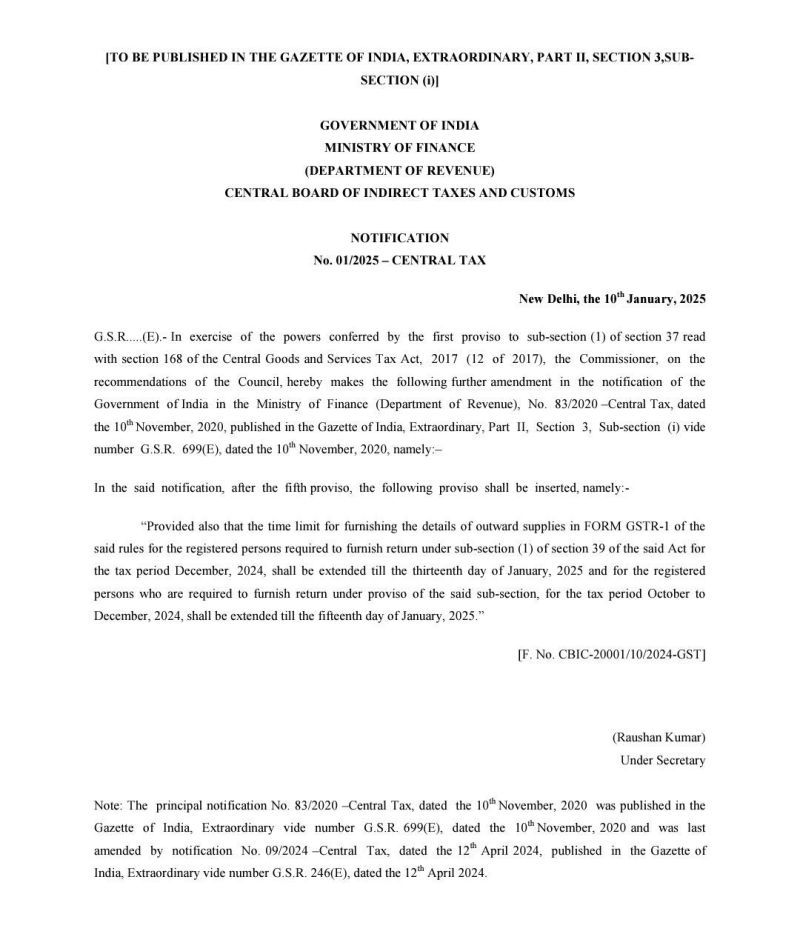
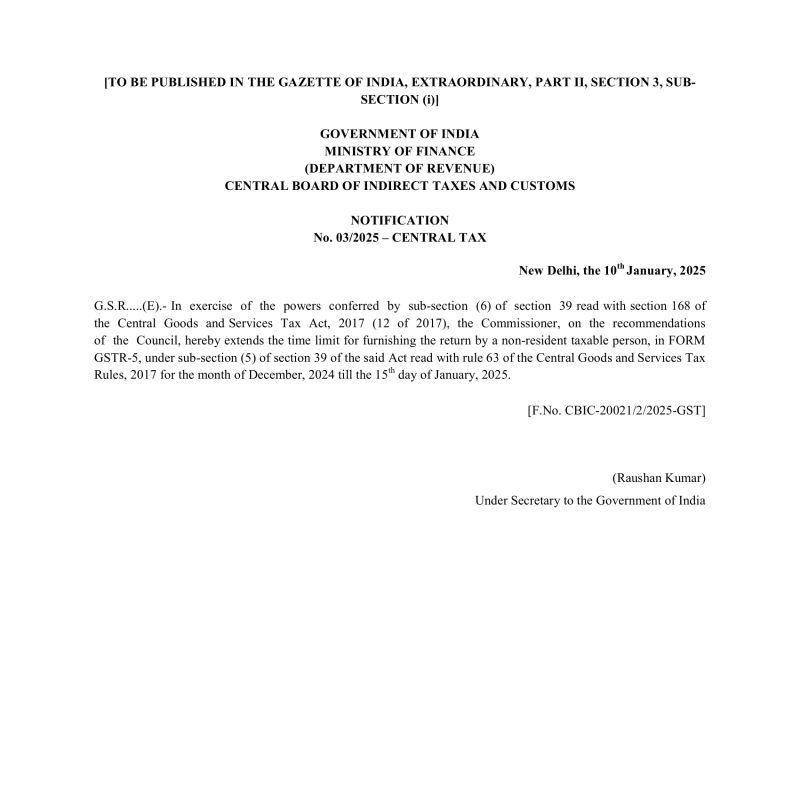
The Goods and Services Tax Network (GSTN) has announced extension of due dates for certain GST returns for the tax period December 2024.

πŸ“… GSTR-5 (Non-Resident Taxable Person Return)
πŸ“… GSTR-6 (Input Service Distributor – ISD)
β€’ Due date extended from 13.01.2025 to 15.01.2025

πŸ“… GSTR-7 (TDS Return)
πŸ“… GSTR-8 (TCS Return)
β€’ Due date extended from 10.01.2025 to 12.01.2025
πŸ“Œ Taxpayers are advised to utilize the extended timeline to ensure timely and accurate filing of returns to avoid late fees or compliance issues.

Stay updated. Stay compliant. βœ…

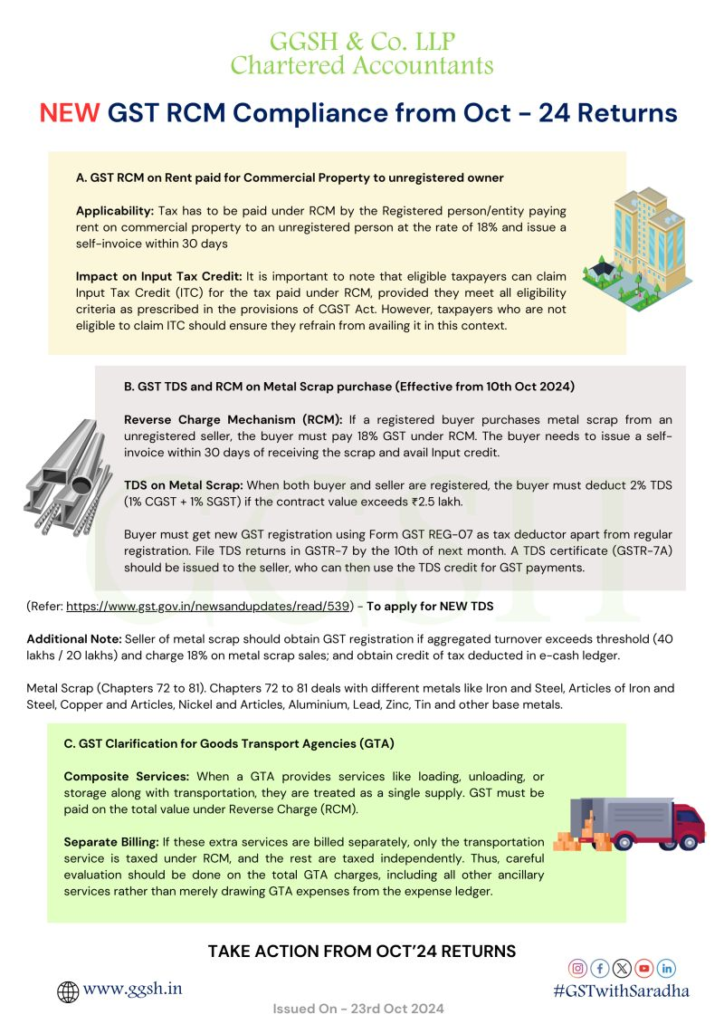
Important GST Update: New Reverse Charge Mechanism (RCM) Compliance Effective from 10 October 2024

Businesses across India must take note of important GST compliance changes related to the Reverse Charge Mechanism (RCM) that became effective from 10 October 2024. These updates affect multiple transactions, including immovable property rentals, metal scrap purchases, and transportation expenses under GTA.

Understanding these changes is essential for proper GST compliance, accurate tax reporting, and timely filing of GST returns such as GSTR-3B. Failure to comply with the new rules may result in tax liabilities, penalties, and input tax credit (ITC) complications.

This article explains the key GST RCM updates applicable from October 2024 and what businesses should do before filing their returns.

Reverse Charge Mechanism (RCM) under GST

The Reverse Charge Mechanism in GST is a system where the recipient of goods or services is liable to pay GST instead of the supplier.

Normally, the supplier collects and pays GST to the government. However, under RCM:

  • The recipient pays the tax directly to the government
  • The recipient may claim Input Tax Credit (ITC) if eligible
  • Additional documentation and compliance requirements apply

RCM is commonly applied in sectors where tax leakage risks are higher or where suppliers may not be registered under GST.

Key GST RCM Changes Effective from 10 October 2024

1. RCM on Immovable Property Rental – 18% GST

A major update concerns rental expenses for immovable property.

Under the new compliance rule:

  • GST at 18% under Reverse Charge Mechanism may be payable on immovable property rental expenses
  • This applies to both residential and commercial property rentals in applicable cases

Businesses must carefully review their rental agreements, lease payments, and GST applicability to ensure proper compliance.

2. GST Compliance Changes for Metal Scrap Transactions

Another important update relates to metal scrap purchases and sales.

The GST treatment may involve:

  • RCM at 18% on metal scrap purchases, or
  • GST TDS at 2%, depending on the transaction and applicable provisions.

These changes affect businesses involved in:

  • Scrap trading
  • Manufacturing industries
  • Recycling businesses
  • Metal processing units

Companies dealing with scrap transactions must ensure that correct tax treatment, documentation, and reporting are followed.

3. RCM on GTA Transportation Including Ancillary Services

Under the updated compliance approach, Reverse Charge Mechanism for Goods Transport Agency (GTA) services must now include ancillary charges.

This means businesses must calculate RCM on the total transportation value, which may include:

  • Freight charges
  • Loading and unloading
  • Packing charges
  • Other related transportation services

This update ensures accurate tax calculation on the full value of transportation services.

Self-Invoicing Requirement for Reverse Charge Transactions

An important compliance requirement for RCM transactions is the self-invoice rule.

Under GST regulations:

  • The recipient must generate a self-invoice when the supplier is not liable to charge GST
  • The self-invoice must be issued within 30 days of receiving the goods or services
  • This documentation is necessary to claim Input Tax Credit (ITC) on RCM payments

Proper documentation is critical to avoid ITC rejection during GST scrutiny or audits.

What Businesses Should Do Before Filing October GST Returns

Before filing the October GST return in November 2024, businesses should take the following steps:

βœ” Review rental expenses and property agreements for RCM applicability
βœ” Check metal scrap purchases and ensure correct GST treatment
βœ” Verify GTA transportation invoices including ancillary services
βœ” Generate self-invoices for RCM transactions within the required timeframe
βœ” Ensure proper reporting in GSTR-3B and other GST returns

Taking proactive steps now can prevent compliance issues, penalties, and mismatches in GST filings.

Conclusion

The new GST Reverse Charge Mechanism (RCM) compliance changes effective from 10 October 2024 introduce important responsibilities for businesses dealing with property rentals, metal scrap transactions, and transportation services.

With stricter documentation requirements and expanded RCM applicability, businesses must ensure accurate GST calculation, timely self-invoicing, and proper reporting in GST returns.Staying updated with GST law changes and reviewing transactions carefully will help businesses maintain smooth compliance and avoid unnecessary tax disputes.

⚠ GSTR-1 & GSTR-3B Due Dates Extended

The Goods and Services Tax Network (GSTN) has announced an extension of due dates for filing GSTR-1 and GSTR-3B.

πŸ“… Monthly (Regular) Filers

β€’ GSTR-1: 13th January
β€’ GSTR-3B: 22nd January

πŸ“… Quarterly Filers (QRMP Scheme)

β€’ GSTR-1: 15th January
β€’ GSTR-3B: 24th / 26th January (extended dates depending on the state)

πŸ“Œ Taxpayers are advised to utilize the extended time to ensure accurate filings and avoid late fees or compliance issues.

Stay updated. Stay compliant. βœ…

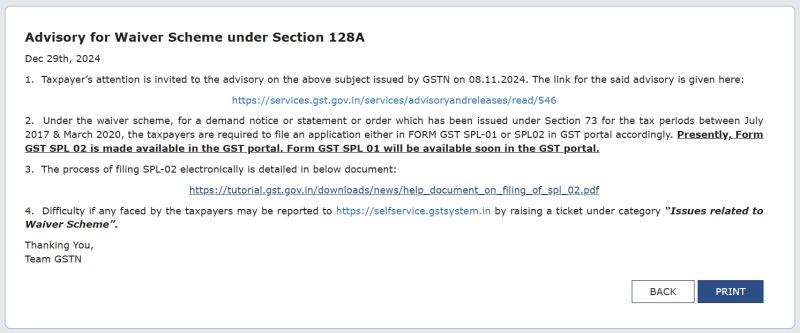
πŸ“’ Important GSTN Update – 29th December 2024

The Goods and Services Tax Network (GSTN) has issued an important update regarding the Waiver Scheme under Section 128A.

πŸ”” Key Update

  • Form GST SPL-02 is now available on the GST portal.
  • Form GST SPL-01 will be made available shortly on the portal.

These forms are part of the amnesty / waiver scheme introduced under Section 128A, which allows taxpayers to obtain waiver of interest and penalty subject to prescribed conditions.

Taxpayers intending to avail the scheme should monitor the GST portal for activation of Form GST SPL-01 and complete the required filings accordingly.

πŸ”— Reference (LinkedIn Update):
https://lnkd.in/gC_hCjPP

Stay updated and ensure timely compliance. βœ…

GST Alert: Duplicate ITC Reflections in GSTR-2B for Oct 2024 – Caution for Taxpayers Filing GSTR-3B

Taxpayers filing the October 2024 GSTR-3B return should exercise extra caution while claiming Input Tax Credit (ITC) based on GSTR-2B. Several professionals have reported instances where ITC already reflected in the September 2024 GSTR-2B is again appearing in the October 2024 GSTR-2B, potentially leading to duplicate ITC claims.

This issue appears to be linked to the Invoice Management System (IMS) and the reporting timeline for QRMP suppliers and Input Service Distributor (ISD) returns.

Businesses must therefore ensure proper ITC reconciliation before filing GSTR-3B to avoid errors, notices, or future reversals.

Why Duplicate ITC Is Appearing in GSTR-2B

The duplication issue mainly arises due to the filing timelines of QRMP suppliers and ISD registrations.

Under the GST framework:

  • QRMP taxpayers file GSTR-1 quarterly
  • ISD registrations file GSTR-6
  • The cut-off date for capturing these transactions in GSTR-2B is typically the 13th of the month

If a QRMP supplier files GSTR-1 for September 2024 on 12th or 13th October, or an ISD files GSTR-6 during this window, the credit may have already appeared in the September 2024 GSTR-2B.

However, due to a possible algorithm or synchronization issue within the IMS system, the same ITC is again reflecting in the October 2024 GSTR-2B.

This creates a risk where taxpayers relying solely on GSTR-2B may accidentally claim duplicate ITC while filing GSTR-3B for October 2024.

Role of IMS in GSTR-2B Data Flow

The Invoice Management System (IMS) introduced by the Goods and Services Tax Network is designed to streamline invoice-level matching and ITC validation.

However, during the initial phase of IMS implementation, certain data synchronization and reporting challenges appear to be affecting how credits are captured in GSTR-2B.

Because GSTR-2B is now influenced by IMS data flows, any discrepancies in the system may result in incorrect or duplicated ITC values being auto-populated in GSTR-3B.

GSTN Advisory on IMS and ITC Reporting

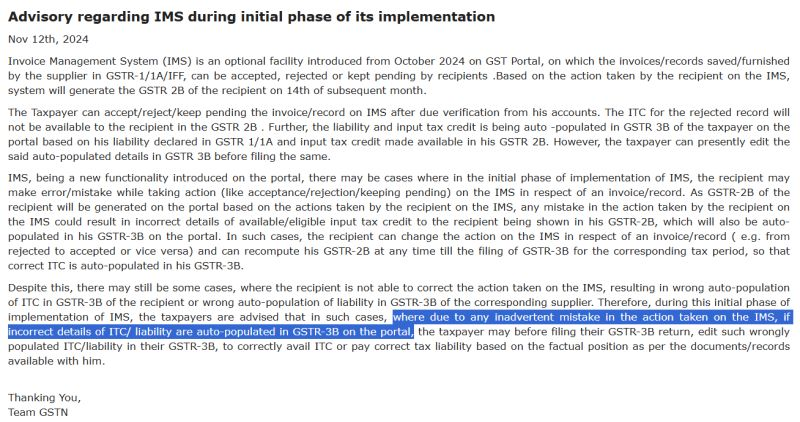
Earlier, the Goods and Services Tax Network had issued an advisory in November explaining that if incorrect ITC or liability values appear auto-populated in GSTR-3B, taxpayers should carefully review and edit the figures before filing the return.

The advisory highlighted that such discrepancies could arise due to inadvertent actions in IMS.

However, many professionals believe that some of the current issues may also stem from system-level glitches during the early stages of IMS implementation.

Action Points for Taxpayers Filing October 2024 GSTR-3B

To avoid compliance issues or duplicate credit claims, taxpayers should follow these important steps before filing their return.

1. Do Not Claim ITC Solely Based on GSTR-2B

While GSTR-2B is an important reference document, ITC claims should not be made solely based on the auto-populated values.

2. Validate ITC with Purchase Records

Taxpayers should reconcile GSTR-2B with purchase registers, invoices, and earlier month credits to ensure accuracy.

3. Check for Duplicate Credits

Special attention should be given to credits from QRMP suppliers and ISD registrations, especially if they were filed around the 12th or 13th of October 2024.

4. Ensure Accurate ITC Calculation

Before filing GSTR-3B, verify that the ITC claimed is correct and does not include duplicate entries.

5. Raise a Grievance if Required

If duplicate credits continue to appear due to system issues, taxpayers may consider raising a grievance through the GST portal for clarification or correction.

Importance of Careful ITC Reconciliation

Claiming incorrect or excess ITC can lead to:

  • GST notices and scrutiny
  • ITC reversal with interest
  • Penalty implications

Therefore, businesses should maintain strong ITC reconciliation practices between purchase records, GSTR-2B, and GSTR-3B to ensure accurate compliance.

Conclusion

The appearance of duplicate ITC entries in October 2024 GSTR-2B, especially related to QRMP suppliers and ISD filings, highlights the importance of careful GST return verification.

With the Invoice Management System (IMS) still in its early stages, taxpayers must exercise extraordinary caution while claiming ITC in GSTR-3B.Rather than relying solely on auto-populated values, businesses should perform detailed reconciliation and validation to avoid duplicate claims and future compliance complications.