Next-Gen GST Reforms in India: Key Decisions from the 56th GST Council Meeting

India’s indirect tax landscape is moving toward a simpler and more streamlined Goods and Services Tax (GST) system. Major policy updates were discussed during the 56th meeting of the GST Council, held on 03 September 2025 in New Delhi.

The meeting of the GST Council marks an important step toward next-generation GST reforms, focusing on tax simplification, rate rationalisation, and sector-specific relief measures.

Announced as part of a broader reform vision by Narendra Modi, these policy updates aim to make the GST framework citizen-centric, business-friendly, and growth-oriented.

The proposed reforms signal the government’s continued commitment to building a predictable, transparent, and future-ready indirect tax regime in India.
Key Highlights of the 56th GST Council Meeting

The latest GST Council meeting introduced several proposals focused on tax relief, industry support, and structural simplification of GST rates.

Relief Measures for Citizens

One of the central themes of the reforms is providing tax relief for individuals and essential services.

Key proposals include:

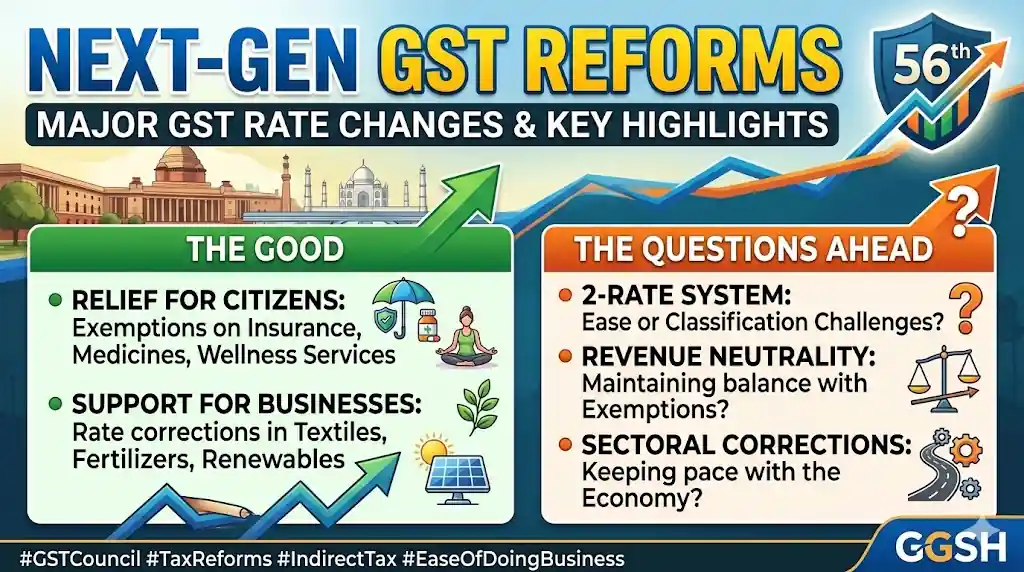
  • GST exemptions or relief for health insurance services
  • Tax relief on lifesaving medicines
  • Concessions for wellness and healthcare-related services

These measures are designed to reduce the financial burden on households and improve access to critical healthcare services.

Support for Key Business Sectors

The reforms also aim to strengthen industries by introducing GST rate corrections in important sectors of the economy, including:

  • Textiles sector
  • Fertilizer industry
  • Renewable energy sector

Such adjustments are expected to enhance competitiveness, supply chain efficiency, and investment attractiveness in these sectors.

By recalibrating GST rates, policymakers are attempting to balance revenue collection with economic growth objectives.

GST Rate Rationalisation: Moving Toward a Two-Rate Structure

One of the most discussed proposals is the possibility of transitioning toward a two-rate GST structure.

Currently, India’s GST system includes multiple tax slabs such as:

  • 5%
  • 12%
  • 18%
  • 28%

A simplified two-rate GST model could significantly reduce classification disputes, compliance complexity, and administrative challenges.

However, tax experts and industry stakeholders are closely evaluating the practical implications of such a structural change.

Key Questions Surrounding the Proposed GST Reforms

While the reform proposals are widely seen as a positive development, several important questions remain.

1. Will a Two-Rate GST System Simplify Compliance?

A reduced number of tax slabs may simplify compliance for businesses. However, classification disputes between categories of goods and services could still arise, requiring clearer guidelines.

2. How Will Revenue Neutrality Be Maintained?

Expanding exemptions and lowering rates in certain sectors raises concerns about maintaining government tax revenues while ensuring fiscal stability.

Policymakers will need to carefully design the new tax structure to ensure revenue neutrality while supporting economic growth.

3. Can GST Reforms Keep Pace with the Evolving Economy?

India’s economy is rapidly evolving, with digital services, renewable energy, and new industries emerging quickly.

Regular sector-specific updates may be necessary to ensure the GST framework remains adaptive, competitive, and aligned with modern economic trends.

Why These GST Reforms Matter for Businesses

For businesses, especially those dealing with GST compliance, tax planning, and supply chain management, these reforms could have significant implications.

Potential benefits include:

  • Simplified GST compliance procedures
  • Reduced tax classification disputes
  • Improved cost predictability
  • Enhanced investment environment

However, successful implementation will require clear government guidelines, consistent interpretation, and effective stakeholder engagement.

Expert Perspective: Implementation Will Be Key

While the announcements from the 56th GST Council meeting represent an important policy inflection point, the real impact will depend on how effectively these reforms are implemented.

A successful rollout will require:

  • Clear sector-specific guidance
  • Smooth transition mechanisms for businesses
  • Continuous policy review and stakeholder consultation

With proper execution, these reforms could strengthen India’s GST ecosystem and improve the ease of doing business.

Final Thoughts

India’s next-generation GST reforms represent a major step toward building a simpler, more predictable, and growth-focused indirect tax system.

As businesses, tax professionals, and policymakers analyze the details of these proposals, the coming months will be crucial in determining how these reforms reshape the GST landscape in India.Stakeholder participation and ongoing policy review will be essential to ensure that the GST system continues to evolve alongside the changing needs of the economy.


Fake Income Tax Verification Email Alert: PIB Fact Check Warns Taxpayers of Phishing Scam

Indian taxpayers are once again being targeted by fraudulent emails impersonating the Income Tax Department. If you recently received an email asking for manual verification of your income tax details, it is important to pause before taking any action.

According to Press Information Bureau through its initiative PIB Fact Check, a viral email claiming to be from the Income Tax Department requesting manual verification is completely fake and part of an ongoing phishing scam targeting taxpayers in India.

Cybercriminals are attempting to trick individuals into clicking malicious links and sharing sensitive information such as financial data, login credentials, or personal identification details.

Understanding how these scams operate can help taxpayers protect their financial identity and prevent online tax fraud.

What Is the Fake Income Tax Manual Verification Email?

Fraudsters are circulating emails that appear to come from the Income Tax Department, claiming that taxpayers must complete a manual verification process.

The email typically:

  • Requests immediate action for verification
  • Contains suspicious links
  • Attempts to create urgency so users click without verifying authenticity

Once the link is clicked, victims may be redirected to fake websites designed to steal sensitive information.

This is a common form of phishing attack, where scammers impersonate government authorities to gain access to personal or financial data.

PIB Fact Check Confirms the Email Is Fake

PIB Fact Check has officially confirmed that the email circulating online claiming to require manual verification from taxpayers is not issued by the Income Tax Department.

Taxpayers are strongly advised not to click any links included in such emails.

Government departments rarely ask for sensitive information through email communications.

Why Income Tax Phishing Emails Are Dangerous

Income tax phishing scams are designed to capture confidential information such as:

  • PAN details
  • Bank account information
  • Income Tax portal login credentials
  • OTP verification codes
  • Personal identification details

Once criminals gain access to this data, they may attempt financial fraud, identity theft, or unauthorized tax filings.

Because millions of Indians file their Income Tax Returns (ITR) online every year, scammers frequently exploit this system to conduct large-scale cyber fraud campaigns.

What Taxpayers Should Do If They Receive Such Emails

If you receive a suspicious email claiming to be from the Income Tax Department, follow these important cybersecurity steps:

1. Never Click Suspicious Links

Avoid clicking on links embedded in emails claiming tax refunds, verification, or account updates unless they are verified from official sources.

2. Do Not Share Sensitive Information

Never disclose personal or financial information such as:

  • OTPs
  • Passwords
  • PAN numbers
  • Bank account details

Government authorities do not request such information through email, SMS, or phone calls.

3. Always Verify Official Communications

Before acting on any tax-related email, confirm its authenticity through official government portals or announcements.

How to Report Fake Income Tax Emails

If you receive a suspicious email related to Income Tax verification or refund processing, report it immediately through the official reporting platform provided by the government.

You can report the fraudulent email here:

👉 https://lnkd.in/gm_pu6mi

Reporting phishing attempts helps authorities track cybercriminal networks and prevent further scams.

Protect Yourself From Income Tax Scams

As digital tax filing becomes more common, cybersecurity awareness among taxpayers is critical.

Always remember:

✔ Do not click unknown or suspicious links
✔ Never share confidential financial information online
✔ Verify tax communications from official government sources

By staying cautious and informed, taxpayers can help create a safer and more secure digital tax ecosystem in India.

Final Thought

Every careful action online helps strengthen cybersecurity.
Let’s build a safer digital space — one cautious click at a time.

𝗞𝗶𝗻𝗱 𝗔𝘁𝘁𝗲𝗻𝘁𝗶𝗼𝗻 𝗧𝗮𝘅𝗽𝗮𝘆𝗲𝗿𝘀!

A new Income Tax refund phishing scam in India is circulating through fraudulent emails that appear to come from the Income Tax Department. Many taxpayers who recently filed their Income Tax Return (ITR) are receiving emails claiming there was an error in tax calculation and a refund needs to be processed.

However, these emails are not legitimate.

They are part of a phishing scam designed to steal sensitive financial information such as bank credentials, OTPs, and login details.

Understanding how this scam works is crucial to protect your taxpayer data, financial identity, and income tax account.

What Is the Fake Income Tax Refund Email Scam?

Cybercriminals are sending fraudulent emails impersonating the Income Tax Department of India.

These emails typically claim:

  • There was an error in calculating your tax
  • You are eligible for an income tax refund
  • You must click a link to process the refund

Once you click the link, you may be redirected to a fake Income Tax portal look-alike website where attackers attempt to collect your:

  • Income Tax login credentials
  • Bank account details
  • PAN information
  • OTPs and verification codes

This type of attack is known as phishing, where scammers attempt to trick users into sharing confidential information.

Fake Email Sender Used in the Scam

One commonly reported sender in this phishing attempt is:

donotreply@incometaxindiafilling.gov.in

⚠ This email address is fake.

Scammers often create domains that look similar to official government domains to deceive taxpayers.

Official Income Tax Department Email Domain

The Income Tax Department of India only communicates through official domains such as:

@incometax.gov.in

Any email sent from a different domain should be treated with caution.

Always verify before clicking links or downloading attachments.

Important Safety Guidelines for Taxpayers

To protect yourself from Income Tax phishing scams, follow these cybersecurity best practices:

1. Do Not Click Suspicious Links

If an email asks you to click a link to claim a tax refund, avoid interacting with it unless you have verified the sender.

2. Verify the Email Domain

Always check if the email originates from the official domain:

@incometax.gov.in

Fake domains often include small spelling changes such as:

  • incometaxindiafiling
  • incometaxrefundservice
  • incometaxverification

3. Never Share Confidential Information

The Income Tax Department never asks for sensitive information through:

  • Phone calls
  • Emails
  • SMS messages

This includes:

  • Passwords
  • OTPs
  • Bank account details
  • Debit/credit card details

4. Access the Portal Directly

Instead of clicking email links, always visit the official Income Tax e-filing portal by typing the website address manually in your browser.

How to Report Income Tax Phishing Emails

If you receive a suspicious email pretending to be from the Income Tax Department, you should immediately report it.

Send the phishing email to:

webmanager@incometax.gov.in

Reporting such emails helps authorities track cybercriminals and prevent further fraud attempts.

Why Income Tax Phishing Scams Are Increasing

With millions of taxpayers filing returns online each year, cybercriminals are increasingly targeting the Income Tax e-filing ecosystem.

The period after ITR filing and refund processing is particularly vulnerable because taxpayers expect communication regarding:

  • Income tax refunds
  • tax calculation corrections
  • verification requests

Scammers exploit this expectation to trick taxpayers into clicking malicious links.

Final Advice for Taxpayers

Always stay cautious when dealing with Income Tax communications, refund emails, and tax-related notifications.

Remember:

✔ The Income Tax Department does not ask for confidential information via email or phone.
✔ Always verify emails from official domains only.
✔ Never click suspicious refund links.

Staying alert is the best way to protect your PAN, bank account, and tax records from cyber fraud.

Stay Alert. Stay Safe.

Madras High Court on Bunching of SCN: Multi-Year Show Cause Notices Held Invalid Under GST Law

In a significant development in GST litigation in India, the Madras High Court has once again reaffirmed its stance against the bunching of Show Cause Notices (SCN) across multiple financial years.

Following the landmark ruling in the Titan Company Ltd case, the High Court has reiterated that issuing combined SCNs for multiple financial years is legally unsustainable.

Background: What is Bunching of SCN in GST?

“Bunching of SCN” refers to the practice where tax authorities:

  • Issue a single Show Cause Notice covering multiple financial years (FYs)
  • Pass a single adjudication order for multiple FYs

This approach is often used to:

  • Include time-barred periods
  • Consolidate multiple issues into one proceeding

However, this practice has been under judicial scrutiny.

Key Case: Ms R A And Co vs AC of Central Taxes

Case Details:

  • Case Name: Ms R A And Co vs Assistant Commissioner of Central Taxes
  • Citation: W.P. No. 17239 of 2025
  • Judgment Date: 21.07.2025

The Madras High Court examined the legality of issuing SCNs and orders covering multiple financial years under GST law.

Key Issue Before the Court

Whether:

A single Show Cause Notice and order covering more than one financial year is valid under Sections 73 and 74 of the CGST Act?

Court’s Ruling: Multi-Year SCNs Are Invalid

The High Court held that:

  • Issuing SCNs covering multiple financial years is bad in law
  • Passing a common order for multiple FYs is invalid
  • Such notices violate the statutory framework of GST law

Accordingly, the court quashed the impugned order.

Legal Reasoning: Financial Year-Based Limitation

The judgment emphasized that:

  • Sections 73 and 74 of the CGST Act prescribe time limits based on “financial year”
  • Each financial year is treated as a separate assessment unit

👉 Therefore, combining multiple financial years into a single SCN:

  • Defeats the intent of limitation provisions
  • Allows inclusion of time-barred demands
  • Violates procedural fairness

Reference to Titan Company Case

The court also relied on its earlier decision in the Titan Company Ltd case, where a similar view was taken.

Despite this clear precedent, the department:

  • Attempted to repeat the same approach
  • Issued combined notices across financial years

The court observed that such repeated errors reflect an unfair approach by tax authorities.

Impact on GST Litigation and Taxpayers

This ruling has significant implications for:

  • Businesses facing GST Show Cause Notices
  • Tax professionals handling litigation
  • Authorities issuing SCNs under GST

Key Takeaways:

  • Each financial year must be assessed separately
  • SCNs cannot club multiple years into one notice
  • Taxpayers can challenge invalid SCNs on limitation grounds
  • Orders based on such notices are liable to be quashed

Practical Guidance for Taxpayers

If you receive a GST SCN:

  • Check whether it covers multiple financial years
  • Verify compliance with Section 73/74 time limits
  • Evaluate if the notice includes time-barred demands

👉 If yes, you may have strong grounds to:

  • Challenge the SCN before authorities or courts
  • Seek relief through writ petitions

Conclusion

The ruling in Ms R A And Co vs AC of Central Taxes strengthens the legal position that bunching of SCNs across financial years is not permissible under GST law.

By reinforcing financial year-based limitation, the Madras High Court has once again protected taxpayers from procedural overreach.

Final Thoughts 💬

Will this ruling put an end to the practice of issuing multi-year GST notices, or will litigation continue on this issue?

Why Filing Your Income Tax Return (ITR) Matters for Visa Applications, Loans, and Financial Credibility

“My visa officer asked me for ITRs and I froze.”

That’s exactly what a freelancer told us during a recent consultation.

He had a strong income.
He had international clients.
He even had a promising project opportunity in Europe.

But when the visa officer asked for three years of Income Tax Returns (ITRs) as financial proof for his visa application, he had nothing to submit.

And just like that, his dream project was delayed — not because he lacked money, but because he lacked documented financial credibility.

This situation is more common than many freelancers, entrepreneurs, and professionals realize.

The Common Misconception About Income Tax Filing

Many professionals believe that filing an Income Tax Return is optional if Tax Deducted at Source (TDS) has already been deducted from their income.

Unfortunately, that assumption can create serious problems later.

While TDS ensures that tax is partially collected by the government, it does not replace the importance of filing your Income Tax Return (ITR).

Your ITR serves as an official financial record of your income, verified and acknowledged by the Income Tax Department.

Without this record, proving your financial standing becomes extremely difficult.

Why ITR Filing Is More Than Just Tax Compliance

Your Income Tax Return (ITR) is not just a regulatory requirement.

It is one of the most widely accepted documents used to verify financial stability, income consistency, and creditworthiness.

Today, multiple institutions rely on ITRs for financial evaluation.

1. Visa Applications and Immigration Processing

Embassies and immigration authorities often ask for 2–3 years of ITRs to assess an applicant’s financial reliability.

These documents help authorities verify:

  • Consistent income history
  • Financial stability
  • Ability to support international travel or relocation

Without proper ITR records, even financially capable applicants may face visa delays or rejections.

2. Home Loan and Personal Loan Approvals

Banks rely heavily on Income Tax Returns when evaluating loan eligibility.

For self-employed individuals, freelancers, consultants, and business owners, ITRs are often the primary proof of income.

Financial institutions typically require:

  • Last 2–3 years of ITR filings
  • Verified income consistency
  • Tax compliance history

Without these records, obtaining a home loan, business loan, or personal loan can become extremely challenging.

3. Higher Credit Card Limits and Creditworthiness

Credit card companies often review ITR filings when deciding:

  • Credit limits
  • Premium credit card eligibility
  • Credit score assessments

A consistent record of timely ITR filing demonstrates responsible financial behaviour.

4. Business Expansion and Investor Confidence

Entrepreneurs seeking investors, venture capital, or business funding are frequently asked to present their Income Tax Returns.

ITRs help investors evaluate:

  • Revenue patterns
  • Business profitability
  • Financial discipline

In many cases, ITRs act as the first financial checkpoint before deeper due diligence begins.

5. Insurance and Financial Risk Assessment

Insurance companies and financial institutions often examine ITRs to determine:

  • Insurance coverage limits
  • Premium eligibility
  • Financial risk profiles

A well-maintained ITR history strengthens your financial credibility and risk profile.

Your ITR Is a Financial Reputation Document

Think of your Income Tax Return as more than a tax form.

It is a financial identity document.

Long before you explain your financial capability to a visa officer, a banker, or an investor, your ITR already tells your story.

It shows:

  • Your income stability
  • Your financial discipline
  • Your tax compliance record
  • Your economic credibility

In many cases, this single document can open doors to global opportunities, funding, and financial growth.

Why Freelancers, Startups, and Professionals Must Prioritize ITR Filing

In today’s digital economy, many professionals earn through:

  • Freelancing platforms
  • International clients
  • Consulting services
  • Startup ventures

But irregular documentation of income can create problems during:

  • Visa processing
  • Loan applications
  • Funding discussions
  • Government compliance reviews

Regular Income Tax Return filing ensures your financial journey is properly documented and recognized.

Filing Your ITR on Time Builds Long-Term Financial Trust

Timely ITR filing does far more than satisfy a legal requirement.

It helps you build:

  • Financial credibility
  • Institutional trust
  • Strong documentation for future opportunities

In many situations, the difference between approval and rejection comes down to whether your financial records are properly documented.

Final Thoughts

Don’t wait for a visa officer, banker, or investor to tell you what’s missing in your financial documentation.

Proactive Income Tax Return filing ensures that when opportunities arrive — whether it’s an overseas project, a home loan, or business funding — you are ready with the right proof.

Because in the world of finance, documentation often speaks before you do.

Need Professional Guidance on ITR Filing?

If you’re unsure about Income Tax Return filing, compliance requirements, or financial documentation, it’s always best to consult a qualified professional.

Proper guidance ensures your ITR filings are accurate, timely, and aligned with your long-term financial goals.

SEO Keywords Used

  • Income Tax Return filing India
  • Importance of ITR for visa application
  • ITR for home loan approval
  • Why freelancers must file ITR
  • Financial proof for visa application India
  • Tax compliance for self-employed professionals
  • Benefits of filing income tax return

When a Tax Deduction Turns Into a Tax Raid: Inside the Income Tax Department’s Crackdown on Bogus ITR Claims

It often begins with a tempting promise.

Claim this deduction and get a bigger tax refund.

For many taxpayers, what seems like a harmless adjustment in their Income Tax Return (ITR) can sometimes turn into a serious compliance issue. Recently, the Income Tax Department of India launched a large-scale verification drive that uncovered how misuse of tax deductions and exemptions has become increasingly systematic.

What initially appears to be a small deduction can, in some cases, escalate into tax notices, investigations, and even search operations when fraudulent claims are detected.

A Nationwide Verification Drive

The verification initiative focuses on identifying bogus deductions and fake refund claims filed in Income Tax Returns.

According to reports from the tax authorities, several taxpayers were found to have filed incorrect or fabricated claims through intermediaries promising unusually high refunds.

The investigation revealed a worrying trend where professional middlemen or agents filed returns using false deductions, fabricated TDS entries, and manipulated refund claims.

In just four months, more than 40,000 taxpayers voluntarily withdrew false claims amounting to over ₹1,045 crore after the department began verification proceedings.

Commonly Misused Tax Deductions and Exemptions

The verification drive has particularly focused on suspicious claims under several provisions of the Income-tax Act, 1961.

Some of the commonly misused sections include:

  • Section 10(13A) of the Income-tax Act, 1961 – House Rent Allowance (HRA) exemption
  • Section 80GGC of the Income-tax Act, 1961 – Donations to political parties
  • Section 80E of the Income-tax Act, 1961 – Deduction on education loan interest
  • Section 80D of the Income-tax Act, 1961 – Medical insurance premium deduction
  • Section 80EE of the Income-tax Act, 1961 – Interest deduction on home loans for first-time buyers
  • Section 80EEB of the Income-tax Act, 1961 – Interest deduction on electric vehicle loans
  • Section 80G of the Income-tax Act, 1961 – Donations to charitable institutions
  • Section 80GGA of the Income-tax Act, 1961 – Donations for scientific research and rural development
  • Section 80DDB of the Income-tax Act, 1961 – Deduction for specified medical treatment

In many cases, taxpayers were encouraged to claim deductions without supporting documents or actual eligibility, leading to incorrect filings.

Fake TDS Entries and Inflated Refund Claims

Another major concern uncovered during the verification drive is the use of fictitious TDS entries to artificially inflate refund amounts.

Some intermediaries reportedly created or manipulated tax return data to show TDS that was never actually deducted or deposited, allowing taxpayers to claim refunds that were not legitimately due.

When the tax department cross-verifies such information with Form 26AS, AIS, and TIS data, discrepancies quickly become visible.

Technology is Changing the Compliance Landscape

The tax administration today relies heavily on data analytics and artificial intelligence tools to detect irregularities in tax filings.

The verification drive uses:

  • AI-driven risk analysis
  • Financial data triangulation
  • Cross-verification with banking and reporting systems
  • Ground-level intelligence gathering

These systems help the department identify unusual patterns such as large refunds relative to reported income, repeated deduction claims, or inconsistencies in financial reporting.

As technology becomes more sophisticated, fraudulent filings are increasingly difficult to conceal.

Why Taxpayers Should Be Careful

Many taxpayers involved in such cases were not necessarily acting with deliberate intent. Instead, they were misled by agents or intermediaries promising unusually high tax refunds in exchange for a commission.

This practice has affected a wide range of individuals, including:

  • Salaried employees
  • Small business owners
  • Entrepreneurs
  • Students filing their first tax returns

Unfortunately, even when the incorrect claim is suggested by a third party, the responsibility for the accuracy of the return ultimately lies with the taxpayer.

Key Takeaways for Taxpayers

To avoid complications with the tax authorities, taxpayers should keep a few important principles in mind:

File accurate returns
Ensure that every deduction or exemption claimed is supported by valid documentation.

Avoid intermediaries promising “easy refunds”
If a tax agent guarantees a large refund without proper explanation, it should raise a red flag.

Respond promptly to tax department notices
If you receive communication from the tax department, addressing it quickly can help resolve the issue before it escalates.

Building a Culture of Responsible Tax Filing

The Income Tax Department continues to emphasize its “Trust Taxpayers First” approach, encouraging voluntary compliance and transparent tax practices.

At the same time, authorities have made it clear that fraudulent filings and misuse of tax provisions will face strict enforcement.

For taxpayers, the safest approach is always to work with trusted tax professionals, maintain proper documentation, and file returns with complete accuracy.Shortcuts may look appealing in the moment, but responsible compliance today can prevent serious complications tomorrow.

Section 80JJAA Tax Deduction: A Hiring Incentive Businesses Should Know About

Expanding your team is often a sign that your business is growing. What many companies may not realize, however, is that hiring new employees can also unlock valuable tax benefits under Indian income tax law.

Under Section 80JJAA of the Income-tax Act, 1961, eligible businesses can claim an additional deduction of 30% on salaries paid to new employees, helping reduce their taxable income while supporting job creation.

This deduction is available to businesses that are subject to tax audit under Section 44AB of the Income-tax Act, 1961, and it can be claimed for three consecutive assessment years.

For growing businesses, this provision can translate into meaningful tax savings while expanding the workforce.

What is the Section 80JJAA Deduction?

Section 80JJAA was introduced to encourage employment generation in India by offering tax incentives to businesses that create new jobs.

The provision allows eligible taxpayers to claim:

  • An additional deduction of 30% of the salary paid to new employees
  • The deduction is available for three consecutive assessment years, beginning from the year in which the employment is generated.

This deduction is over and above the normal salary expense deduction, making it an attractive tax planning opportunity for businesses.

Who Can Claim This Deduction?

The benefit under Section 80JJAA is available to business entities that are required to undergo tax audit under Section 44AB.

Eligible businesses must maintain proper payroll records and ensure that all conditions prescribed under the law are satisfied.

For organizations that are expanding their teams, particularly in labour-intensive sectors, this provision can significantly reduce the effective tax burden on employment costs.

Key Conditions for Claiming the Deduction

While the deduction is attractive, it is not automatic. Businesses must satisfy several conditions to qualify for the benefit.

1. Minimum Employment Period

New employees must work for at least:

  • 240 days during the financial year, or
  • 150 days in certain specified sectors such as manufacturing of apparel, footwear, and leather products.

Employees who do not meet this minimum period may not qualify for the deduction.

2. Salary Threshold

The deduction is applicable only if the monthly salary of the new employee does not exceed ₹25,000.

Employees earning above this threshold will not be considered for the purpose of calculating the deduction.

3. Provident Fund Coverage

The new employee must be enrolled under a recognized Provident Fund (PF) scheme.

This ensures that the benefit is available only for formal employment where statutory employee benefits are provided.

4. Filing of Form 10DA

To claim the deduction, businesses must file **Form 10DA along with their income tax return.

This form must be certified by a Chartered Accountant, confirming that the conditions under Section 80JJAA have been satisfied.

Proper documentation and certification are essential for successfully claiming the deduction.

Situations Where the Deduction May Not Apply

There are certain situations where the deduction under Section 80JJAA may not be available.

For example, the deduction will not apply if:

  • The employee’s salary exceeds ₹25,000 per month
  • The employee is not covered under a recognized PF scheme
  • The employee does not meet the minimum employment period requirement
  • The business is formed by splitting up, reconstruction, or acquisition of an existing business

Businesses should therefore review these conditions carefully before claiming the deduction.

A Strategic Tax Benefit for Growing Businesses

For companies planning to expand their workforce, the deduction under Section 80JJAA offers a strategic advantage.

By allowing businesses to claim an additional 30% deduction on eligible employee salaries, the provision helps:

  • Reduce the overall tax liability
  • Encourage formal employment
  • Support business expansion and job creation

When properly planned and documented, this incentive can become a valuable component of tax-efficient workforce planning.

The Bottom Line

Hiring new employees not only strengthens your organization but can also lead to significant tax savings under Section 80JJAA of the Income-tax Act.

However, the benefit comes with specific eligibility conditions, documentation requirements, and compliance obligations.

Businesses that understand these rules and plan accordingly can turn workforce expansion into a smart tax planning opportunity.Sometimes, the most effective tax strategies begin with understanding the fine print.

CBDT Notifies IREDA Bonds as Long-Term Specified Assets Under Section 54EC of the Income-tax Act

In a significant development for investors and taxpayers looking to save capital gains tax in India, the Government has notified bonds issued by the Indian Renewable Energy Development Agency (IREDA) as long-term specified assets under **Section 54EC of the Income-tax Act, 1961.

This update comes through Notification No. 73/2025 dated 9 July 2025, issued by the Central Board of Direct Taxes (CBDT).

With this notification, taxpayers who earn long-term capital gains can now claim capital gains tax exemption by investing in eligible IREDA bonds, subject to the conditions prescribed under Section 54EC.

What the Notification Means for Investors

As per the latest notification, IREDA bonds issued on or after 9 July 2025 and redeemable after five years will be treated as long-term specified assets for the purpose of claiming exemption under Section 54EC.

This means taxpayers who have earned long-term capital gains from the sale of land, building, or other eligible capital assets can reinvest the gains in these bonds to claim capital gains tax exemption.

Such investments must comply with the rules and limits prescribed under the Income-tax Act.

Understanding Section 54EC Capital Gains Exemption

Section 54EC of the Income-tax Act allows taxpayers to save tax on long-term capital gains by investing in specified bonds issued by government-notified entities.

Key features of the exemption include:

  • Investment must be made in specified bonds notified by the government
  • The investment must be made within 6 months from the date of transfer of the capital asset
  • The bonds carry a minimum lock-in period of five years
  • There is a maximum investment limit of ₹50 lakh in a financial year

Until now, certain infrastructure bonds such as those issued by entities like National Highways Authority of India (NHAI) and Rural Electrification Corporation (REC) were commonly used for claiming this exemption.

With the latest notification, IREDA bonds now join the list of eligible investments for Section 54EC tax exemption.

Promoting Renewable Energy Investments

Beyond tax benefits, this move also aligns with India’s broader focus on green infrastructure and sustainable development.

The inclusion of IREDA bonds under Section 54EC is expected to:

  • Encourage investment in renewable energy infrastructure
  • Provide additional tax-saving opportunities for investors
  • Support long-term financing of green energy projects in India

This step strengthens the government’s efforts to promote self-sustaining renewable energy initiatives while offering investors a compliant tax planning avenue.

Legal Basis for the Notification

The notification has been issued under the authority provided by clause (ba) of the Explanation to Section 54EC of the Income-tax Act, 1961, which empowers the Central Government to notify eligible bonds as long-term specified assets for the purpose of capital gains exemption.

What Taxpayers Should Keep in Mind

Taxpayers planning to claim Section 54EC capital gains exemption should consider the following:

  • Ensure the bonds are issued on or after 9 July 2025
  • Confirm that the bonds have a minimum redemption period of five years
  • Invest within six months from the date of transfer of the capital asset
  • Ensure the investment does not exceed the ₹50 lakh limit

Proper documentation and timely investment are essential to successfully claim the capital gains tax exemption.

A Strategic Opportunity for Tax Planning

The notification of IREDA bonds as eligible investments under Section 54EC expands the options available to taxpayers seeking capital gains tax relief.

At the same time, it encourages investment into renewable energy and green infrastructure projects, aligning tax incentives with India’s sustainability goals.For investors with long-term capital gains, this development offers a strategic opportunity to combine tax planning with sustainable investment.

“Wait… Where Did This ₹85,000 Income Come From?” – Why Checking Form 26AS Before Filing ITR Is Crucial

Wait… where did this ₹85,000 income come from?

That was the exact reaction from a client during a routine income tax return (ITR) review. As we sat together going through his Form 26AS, an unexpected entry appeared — dividend income from shares he had purchased years ago.

He had completely forgotten about those investments. Life had moved on, markets had fluctuated, and those shares had slipped out of his active financial memory.

But the company hadn’t forgotten.

Over the years, it had been quietly declaring dividends, and the income was being credited regularly. Alongside that, Tax Deducted at Source (TDS) was also being deducted and reported to the tax authorities.

The income wasn’t hidden. In fact, it had been sitting in plain sight in his Annual Information Statement (AIS), Taxpayer Information Summary (TIS), and Form 26AS all along.

He simply never checked.

Form 26AS – Your True Tax Mirror

Many taxpayers treat Form 26AS as just another document while filing their income tax return in India.

But in reality, it is far more important.

Form 26AS acts as a comprehensive tax statement that reflects the financial information already available with the Income Tax Department of India.

It captures details such as:

  • TDS deducted by employers, banks, or companies
  • TCS collected on certain transactions
  • Dividend income reported by companies
  • High-value financial transactions
  • Tax payments made by the taxpayer

In simple terms, Form 26AS shows what the tax department already knows about your income.

And sometimes, it reveals information that taxpayers themselves may have forgotten.

How Forgotten Income Can Lead to Tax Notices

In many cases, taxpayers miss reporting certain income sources because they are unaware or have simply forgotten about them.

Common examples include:

  • Dividend income from old share investments
  • Interest income from dormant bank accounts
  • Capital gains from mutual fund transactions
  • Rental income credited through automated transfers

Even if you forget to report it in your ITR filing, the data is already available to the tax department through AIS and TIS reporting systems.

When your filed return does not match the data available with the department, it can lead to:

  • Income tax notices
  • Mismatch queries
  • Additional tax demands
  • Penalty or scrutiny proceedings

A simple review of Form 26AS could prevent these complications.

AIS and TIS – Expanding the Tax Transparency Framework

Along with Form 26AS, taxpayers should also review two important statements:

Annual Information Statement (AIS)

The AIS provides a detailed view of financial transactions reported to the tax department, including:

  • Dividend income
  • Securities transactions
  • Mutual fund purchases and redemptions
  • Interest income
  • Foreign remittances

Taxpayer Information Summary (TIS)

The TIS is a simplified summary of AIS data, presenting consolidated values that the tax department uses for compliance monitoring.

Together, AIS, TIS, and Form 26AS provide a complete picture of your financial activity from the tax department’s perspective.

A Simple 10-Minute Checklist Before Filing Your ITR

Before submitting your Income Tax Return (ITR), it is worth spending a few minutes reviewing your tax records.

Here is a simple checklist that can help avoid future issues:

1. Review Form 26AS

Check for TDS entries on income sources such as:

  • Dividend income
  • Interest from banks and deposits
  • Salary payments
  • Rent receipts
  • Consultancy or professional fees

2. Review AIS and TIS

Look for additional financial transactions including:

  • Dividend payouts
  • Capital gains from shares or mutual funds
  • Securities trading activity
  • Other reported financial transactions

3. Reconcile with Your Records

Compare all entries with:

  • Bank statements
  • Investment records
  • Income documents

Any mismatch should be clarified before filing the return.

Just 10 Minutes Can Save a Lot of Trouble

Reviewing your Form 26AS, AIS, and TIS before filing your ITR takes only a few minutes.

But those few minutes can prevent:

  • Stressful tax notices
  • Income mismatches
  • Additional tax liabilities
  • Time-consuming follow-ups with the tax department

A quick review ensures that your tax return accurately reflects all reported income.

The Bottom Line

Think of Form 26AS as your personal tax mirror.

It doesn’t just show what you remember earning — it shows what the tax department already knows about your financial activity.

Before filing your next Income Tax Return in India, take a moment to check your Form 26AS, AIS, and TIS.That small step can help you file your return with confidence, clarity, and complete compliance.

Section 80-IAC Tax Exemption for Startups: How Founders Can Claim 100% Tax Deduction

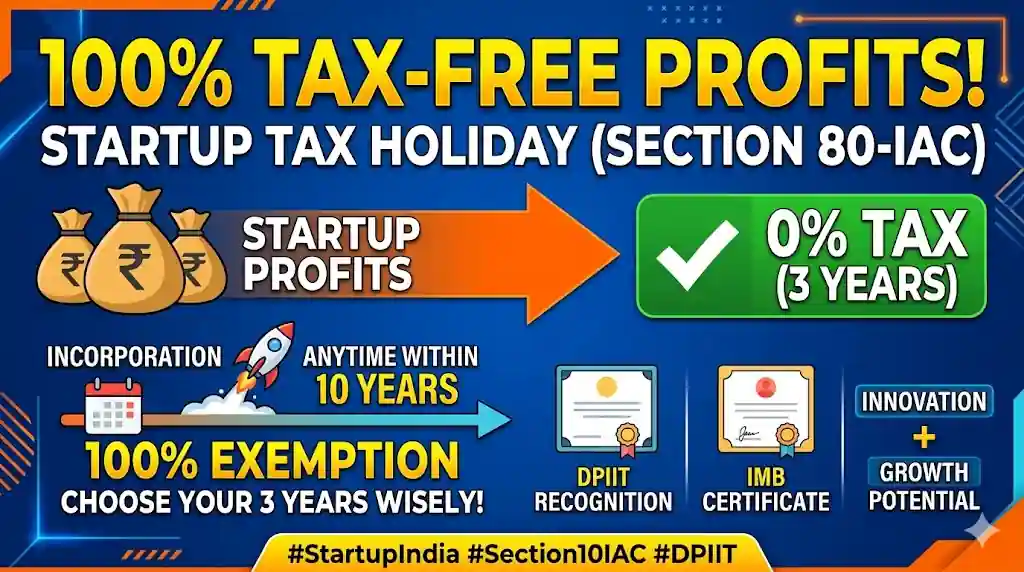
India’s startup ecosystem continues to grow rapidly, and the government has introduced several tax incentives to support innovation and entrepreneurship. One of the most valuable benefits available to eligible startups is the 100% tax deduction on profits for three consecutive years under Section 80‑IAC of the Income-tax Act, 1961.

For startup founders and entrepreneurs, this provision can significantly reduce the tax burden during the crucial early years of growth and scaling.

However, while the benefit is attractive, it comes with specific eligibility conditions and timing considerations that founders must carefully plan for.

What is Section 80-IAC Tax Deduction for Startups?

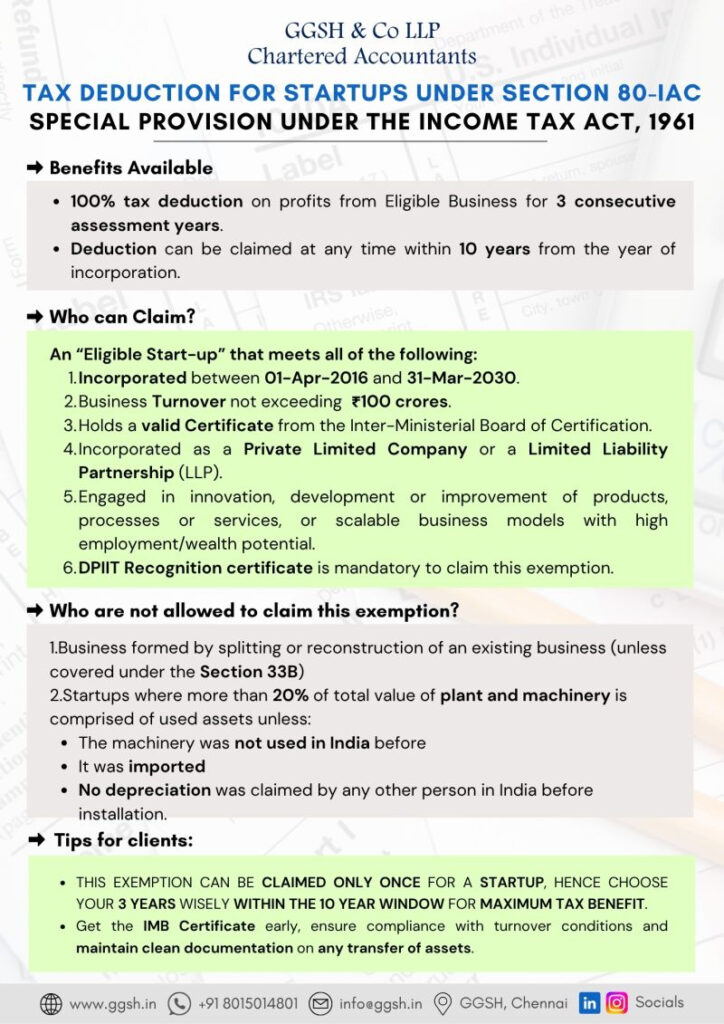
Under Section 80-IAC of the Income-tax Act, eligible startups can claim a 100% deduction on profits for any three consecutive years.

This means that the profits earned during the selected three years can be fully exempt from income tax, provided the startup meets all the prescribed conditions.

The objective of this provision is to encourage innovation, promote entrepreneurship, and support early-stage businesses in India.

Flexibility in Choosing the Deduction Period

One of the most beneficial aspects of the startup tax exemption under Section 80-IAC is the flexibility in timing.

Eligible startups can claim the deduction anytime within 10 years from the date of incorporation.

However, there is an important catch:
The 100% profit deduction can only be claimed once for a block of three consecutive years.

This means founders must carefully choose the three years when the startup is likely to generate meaningful profits in order to maximize the benefit.

Strategic tax planning becomes crucial here, especially during the scale-up phase of the business.

Key Eligibility Requirements for Startup Tax Exemption

To claim the Section 80-IAC tax benefit, startups must satisfy certain regulatory requirements.

1. DPIIT Recognition

The startup must obtain official recognition from the Department for Promotion of Industry and Internal Trade (DPIIT) under the Government of India’s Startup India initiative.

This recognition establishes the entity as an eligible startup under the Startup India framework.

2. IMB Certification

In addition to DPIIT recognition, startups must also obtain approval from the Inter-Ministerial Board (IMB) to claim the tax exemption.

This certification ensures that the startup meets the innovation and scalability criteria prescribed under the law.

3. Proper Documentation and Compliance

Startups must maintain clear documentation and regulatory compliance to support their eligibility for the deduction.

This typically includes:

  • Incorporation records
  • DPIIT recognition certificate
  • IMB approval documentation
  • Financial statements and tax filings

Proper documentation is essential to ensure smooth verification during tax assessments.

4. Innovative and Scalable Business Model

The startup must demonstrate that its business model involves innovation, development, or improvement of products, processes, or services, and has potential for scalability and employment generation.

This condition ensures that the benefit is directed toward high-growth and innovation-driven startups.

Why the Timing of the Deduction Matters

Since the Section 80-IAC deduction is available only once, founders should carefully plan when to claim it.

Many startups do not generate significant profits during the early years. Claiming the deduction too early may therefore limit the financial benefit.

A better strategy is often to claim the deduction during the years when the startup reaches profitability or rapid scaling, maximizing the tax savings.

A Valuable Opportunity for Startup Growth

For eligible startups, the 100% tax deduction under Section 80-IAC can significantly ease the financial pressure during the growth phase.

By reducing the tax liability for three years, startups can redirect their resources toward:

  • Business expansion
  • Product development
  • Hiring and talent acquisition
  • Market scaling

With proper planning and compliance, this tax incentive can play an important role in supporting the long-term success of startups in India.