📢 Important Update – GST Amnesty Scheme (SPL Form Filing)

The Goods and Services Tax Network (GSTN) has issued an advisory regarding filing of the SPL application form under the GST Amnesty Scheme.
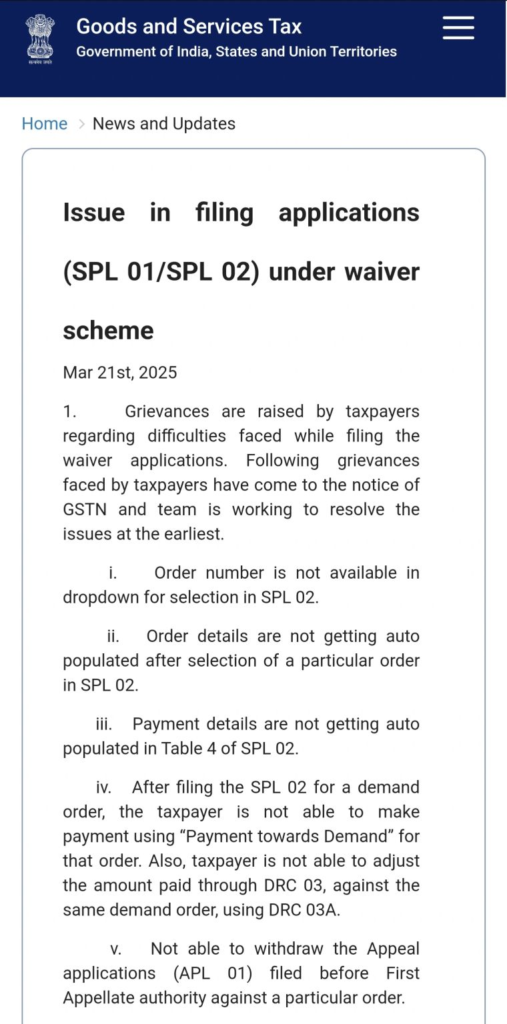
Here are the key takeaways—keeping it short and simple:

🔍 Key Clarification

1️⃣ 31st March 2025 is the cut-off date only for payment of full tax liability to become eligible under the amnesty scheme.
It is NOT the last date for filing the SPL application form.

2️⃣ Taxpayers facing portal-related issues while filing the SPL form need not panic.
The GSTN technical team is currently working on resolving these portal challenges.

✅ This clarification provides much-needed relief to taxpayers who were concerned about missing the deadline due to technical glitches.

📄 You can check the detailed advisory here:
https://lnkd.in/ggAWibQE

#GST #GSTAmnestyScheme #GSTUpdate #GSTN #TaxCompliance
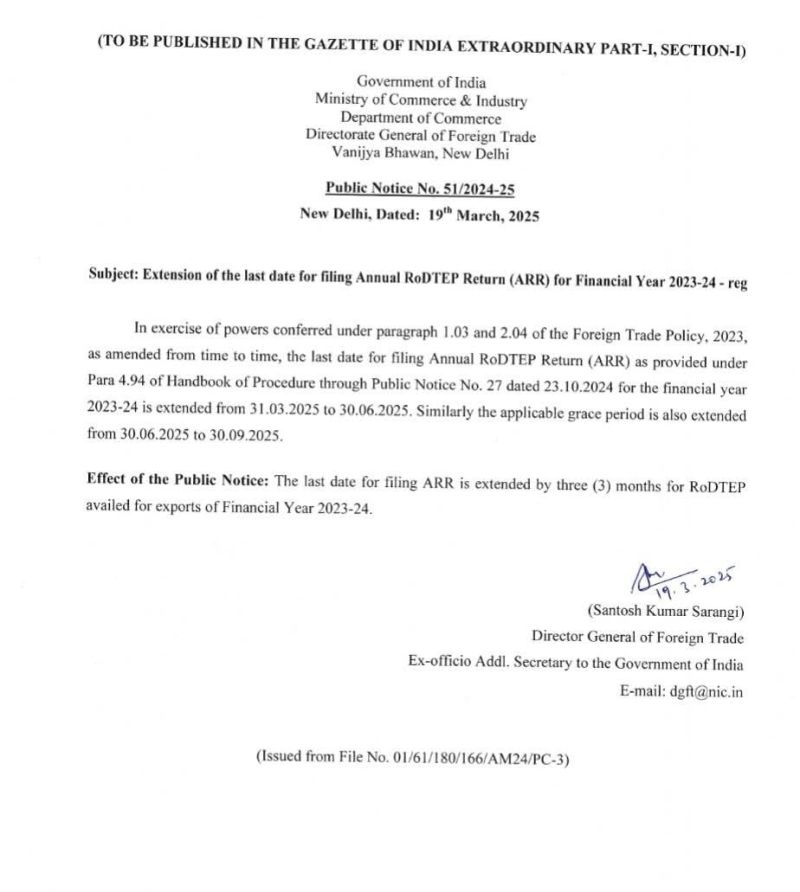
📢 RoDTEP Update – ARR Filing Due Date Extended

Good news for exporters!

The last date for filing the Annual RoDTEP Return (ARR) for FY 2023–24 has been extended to 30th June 2025.

The Directorate General of Foreign Trade (DGFT) has provided this extension to give exporters additional time to complete their compliance under the **Remission of Duties and Taxes on Exported Products (RoDTEP) scheme.

What Exporters Should Do

✔ Ensure accurate reconciliation of RoDTEP claims
✔ Verify shipping bill data and claim details
✔ Complete ARR filing within the extended deadline

Timely filing is important to avoid complications in RoDTEP benefits and future compliance requirements.

New Deadline: 30th June 2025

Exporters who have not yet filed their ARR should utilize this extension to complete the process smoothly.

#RoDTEP #ExportCompliance #DGFT #ForeignTrade #Exporters

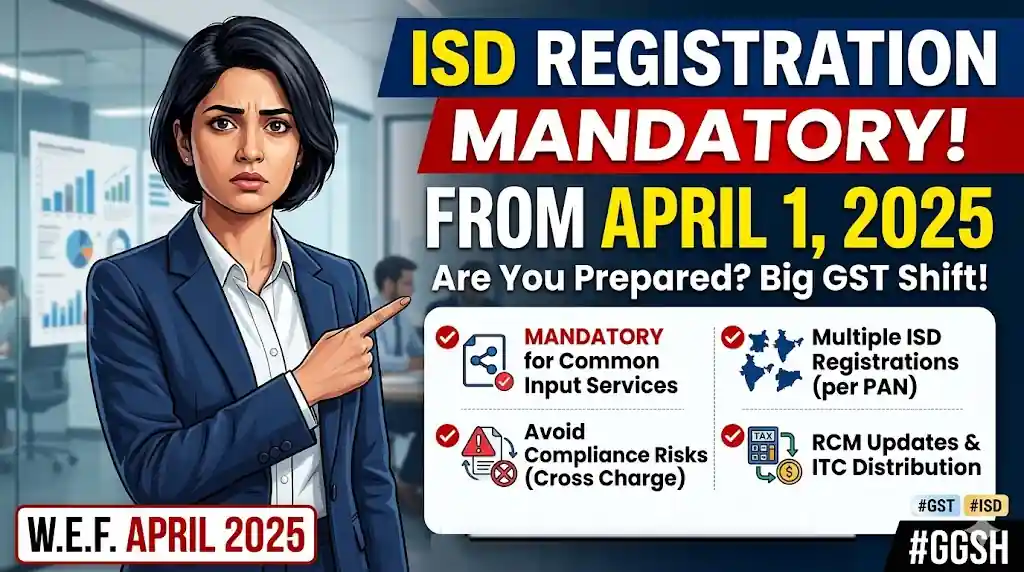
📢 ISD Registration Mandatory from 1 April 2025 – Are Businesses Prepared?

A major compliance shift is coming under GST. From 1 April 2025, Input Service Distributor (ISD) registration will become mandatory for businesses distributing common input service credits across multiple GST registrations.

Businesses with multiple GSTINs under the same PAN should urgently revisit their vendor invoicing structure and input service procurement model.

This change could significantly impact how ITC is distributed within organizations.

🔑 Key Takeaways

ISD Registration No Longer Optional
Businesses utilizing common input services must obtain ISD registration under the GST framework.

Multiple ISD Registrations Possible
A single PAN can have multiple ISD registrations across different states, depending on operational structure.

Cross Charge vs ISD – Critical Distinction
Many businesses currently rely on cross charge mechanisms, but misunderstanding the difference between cross charge and ISD distribution may lead to compliance risks and litigation.

RCM Related Clarifications
Recent updates also affect Reverse Charge Mechanism (RCM) payments and the distribution of ITC through ISD, though detailed procedural clarification is still expected from the Central Board of Indirect Taxes and Customs (CBIC).

⚠ What Businesses Should Do Now

• Review vendor invoicing patterns
• Identify common input services used across branches
• Evaluate whether ISD registration is required
• Align ITC distribution mechanisms before April 2025

This change marks a significant shift in GST compliance, and early preparation will help businesses avoid disruptions and compliance risks.

#GST #ISD #InputServiceDistributor #GSTCompliance #ITC #TaxUpdates

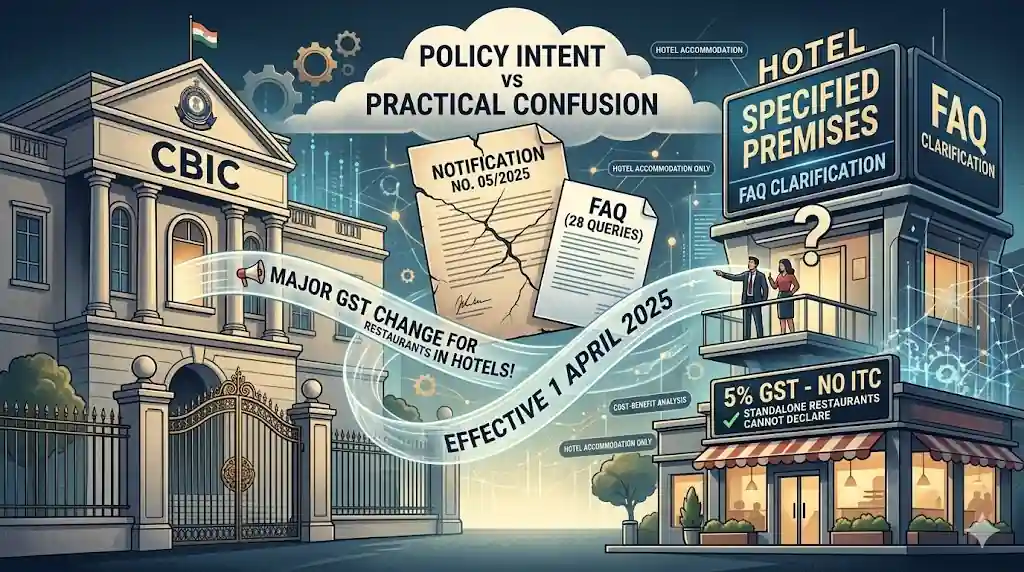
📢 Major GST Change for Restaurants in Hotels – Effective 1 April 2025

A significant shift in GST compliance is coming with the redefinition of “Specified Premises” for determining the GST rate applicable to restaurants located within hotel accommodations.

The change comes through Notification No. 05/2025 dated 16 January 2025, issued by the Central Board of Indirect Taxes and Customs (CBIC).

While linking the definition to previous FY supplies is a welcome move, the notification itself introduced certain ambiguities and practical concerns.

To address this, CBIC issued an FAQ dated 27.03.2025, clarifying 28 practical queries related to the concept of “Specified Premises.”

🔎 Where the Confusion Arose

The confusion mainly arose due to clause (c) in the definition of “Specified Premises”, which states:

“A premises for which a person applying for registration has filed a declaration within fifteen days of obtaining acknowledgement for the registration application declaring the said premises to be a specified premises.”

Notably, this clause did not explicitly refer to hotel accommodation, creating doubts whether standalone restaurants could also opt for the declaration.

📄 Clarification Through FAQ

The FAQ issued by Central Board of Indirect Taxes and Customs clarifies this in FAQ No. 5:

Only persons supplying or intending to supply hotel accommodation services can file this declaration.

In other words, standalone restaurants cannot opt for “Specified Premises” declaration.

Interestingly, this clarification has been issued through FAQ without a corresponding corrigendum to Notification 05/2025, which itself reflects the level of complexity surrounding this change.

📌 Practical Takeaways

Standalone Restaurants

✔ Continue with 5% GST without ITC
✔ Avoid unnecessary experimentation with the “Specified Premises” declaration.

Restaurants within Hotels

✔ This is the crucial time to conduct a cost-benefit analysis
✔ Decide whether to file the Annexure declaration before 31 March 2025.

💭 Final Thought

The policy intent of the GST Council may have been straightforward, but the implementation has introduced considerable confusion, as evident from the extensive FAQ clarifications.

And as for a 29th FAQ on extension of timelines…
That may be known only to God and Government!

#GST #RestaurantGST #HospitalityIndustry #CBIC #GSTUpdates #TaxCompliance

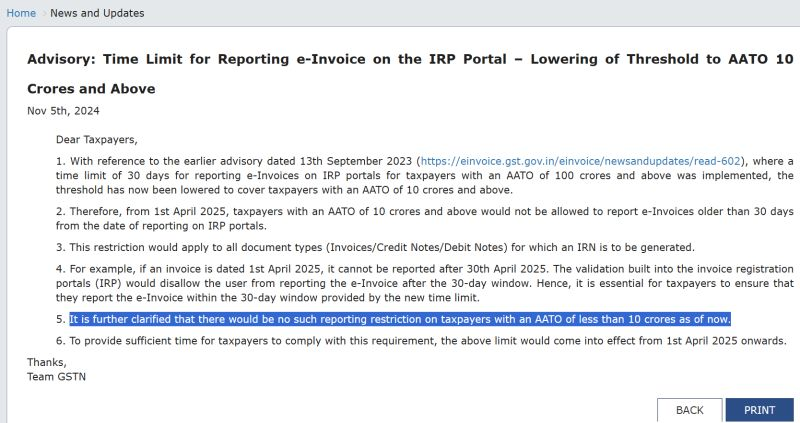
GST Update: 30-Day Time Limit for E-Invoice Reporting Reduced to ₹10 Crore Turnover from April 2025

A significant update in the GST e-invoicing framework will impact businesses with higher turnover starting 1 April 2025. As per the latest advisory from the Goods and Services Tax Network, the 30-day time limit for reporting invoices to the e-invoice portal will now apply to taxpayers with Annual Aggregate Turnover (AATO) above ₹10 crore, replacing the earlier threshold of ₹100 crore.

This change is aimed at improving real-time invoice reporting, tax compliance, and transparency in GST transactions. At the same time, the advisory also clarifies an important point for smaller taxpayers.

What is the 30-Day Time Limit for E-Invoice Reporting?

Under the GST e-invoicing system, eligible taxpayers must upload invoice details to the Invoice Registration Portal (IRP) to generate an Invoice Reference Number (IRN).

Previously:

  • The 30-day reporting restriction applied only to taxpayers with AATO above ₹100 crore.

Now, from 1 April 2025, the rule will apply to taxpayers with:

  • Annual Aggregate Turnover above ₹10 crore

This means such businesses must report invoices to the IRP within 30 days of the invoice date. After this period, the invoice cannot be reported or validated on the e-invoice portal, which may create compliance issues.

No Reporting Restriction for Businesses Below ₹10 Crore

A key clarification in the advisory is that taxpayers with an AATO below ₹10 crore currently have no such reporting time restriction.

This means:

  • There is no 30-day limit for e-invoice reporting for businesses below ₹10 crore turnover.
  • They can generate e-invoices without the system blocking reporting based on the invoice date.

This clarification is important because many compliance disputes have arisen in the past due to misunderstandings around the absence of a reporting time limit.

Impact on GST Compliance and Business Operations

The reduction of the threshold from ₹100 crore to ₹10 crore turnover will significantly increase the number of businesses affected by the 30-day e-invoice reporting requirement.

Businesses should prepare for:

  • Stronger internal invoice reporting controls
  • Timely uploading of invoices to the IRP
  • Better coordination between accounting teams and ERP systems
  • Monitoring of invoice dates and IRN generation timelines

Failure to comply may lead to inability to generate valid e-invoices, which can impact GST return filing, input tax credit claims, and compliance verification during audits.

E-Invoice Absence and Goods Detention under Section 129

One of the practical issues faced by businesses relates to detention of goods during transit due to absence of e-invoice or IRN, often invoked under **Central Goods and Services Tax Act, 2017 Section 129.

In several cases, tax officers have detained goods when e-invoices were not generated at the time of transportation, especially for taxpayers with turnover below ₹100 crore.

However, taxpayers often argued that:

  • The GST advisory allowed 30 days for reporting invoices, or
  • No time restriction existed for taxpayers below the specified threshold

This led to conflicting interpretations between taxpayers and enforcement authorities.

Does the New Advisory Provide Relief?

The updated advisory provides greater clarity by explicitly stating that taxpayers with turnover below ₹10 crore currently have no reporting restriction.

This clarification may help strengthen the argument that:

  • Absence of e-invoice within a specific timeframe cannot automatically be treated as non-compliance for such taxpayers.
  • Detention of goods purely on this ground may require careful legal interpretation and justification.

While the advisory does not directly amend enforcement provisions, it reduces ambiguity surrounding the reporting time limit.

What Businesses Should Do Before April 2025

Businesses with turnover above ₹10 crore should start preparing now to comply with the upcoming rule.

Recommended steps include:

✔ Updating ERP and accounting systems to ensure timely e-invoice generation
✔ Monitoring invoice reporting timelines to avoid delays beyond 30 days
✔ Training accounting teams on the revised e-invoice compliance rules
✔ Reviewing logistics documentation to avoid transit issues

Early preparation will help businesses avoid system blocks, compliance risks, and operational disruptions.

Conclusion

The GST advisory reducing the 30-day e-invoice reporting threshold from ₹100 crore to ₹10 crore turnover marks a significant expansion of the e-invoicing compliance framework.

While the change increases compliance obligations for many businesses, it also brings an important clarification: taxpayers with turnover below ₹10 crore currently have no reporting time restriction.As the new rule becomes effective from 1 April 2025, businesses should review their invoice reporting processes and GST compliance systems to ensure smooth implementation and avoid potential disputes.

ISD Registration Mandatory from April 1, 2025 – Are Businesses Prepared?

From April 1, 2025, the GST framework is witnessing an important compliance shift that businesses with multiple GST registrations under the same PAN cannot afford to overlook.

The Input Service Distributor (ISD) mechanism, which earlier remained optional in many cases, is now becoming a mandatory compliance requirement for distributing common input service credits. This change requires businesses to carefully reassess their vendor invoicing structure, input service procurement, and internal credit distribution processes.

For organizations operating across multiple states, this development is more than just a procedural update—it requires a structural realignment of GST practices.

Understanding the Shift

Many businesses operate with a centralized procurement system where common services such as software subscriptions, professional services, consulting fees, marketing expenses, or corporate support services are billed to one GST registration.

However, these services are often used by multiple units or branches located in different states.

Earlier, companies sometimes used a mix of cross-charge mechanisms or informal allocation methods to distribute the Input Tax Credit (ITC). With the upcoming changes, the law expects such credits to be distributed strictly through the ISD mechanism wherever applicable.

This essentially means that businesses must evaluate whether their existing credit distribution approach aligns with the revised compliance expectations.

Why ISD Registration Matters Now

The mandatory nature of ISD registration introduces a more structured approach to credit distribution. Businesses that avail common input services across multiple GST registrations will now need to ensure proper routing of credits through an ISD registration.

Failing to adopt the correct mechanism may create ITC mismatches, audit queries, and potential compliance risks in the future.

The change is intended to bring greater transparency and traceability in the flow of input tax credits across related registrations.

Multiple ISD Registrations Under One PAN

Another important aspect businesses should note is that a single PAN can hold multiple ISD registrations across different states.

This flexibility allows organizations to design their credit distribution structure based on operational convenience, especially when multiple head offices or administrative centers are involved in procuring shared services.

Businesses should therefore evaluate:

  • Where the common services are typically invoiced
  • Which location should function as the ISD registration
  • Whether multiple ISDs may be required across states

Cross Charge vs ISD – A Common Area of Confusion

One of the most misunderstood areas in GST compliance is the distinction between Cross Charge and ISD distribution.

Both mechanisms deal with transactions between related registrations under the same PAN, but they apply in different circumstances.

  • ISD is specifically used for distribution of input tax credit on common input services.
  • Cross charge, on the other hand, applies when actual services are provided by one branch to another branch.

Using the wrong mechanism may lead to incorrect tax treatment or denial of credits, making it essential for businesses to clearly identify which method applies to each scenario.

Reverse Charge Mechanism (RCM) – Awaiting Procedural Clarity

Recent updates have also brought discussions around how Reverse Charge Mechanism (RCM) payments interact with ISD credit distribution.

While the broad framework has been clarified, certain procedural aspects still require further guidance from the CBIC. Businesses should therefore stay alert for upcoming notifications or circulars that may define the exact process for handling RCM credits within the ISD framework.

What Businesses Should Do Now

With the deadline approaching, businesses should begin evaluating their current GST structures and internal processes.

Some practical steps include:

  • Reviewing vendor invoicing patterns for common services
  • Identifying services used by multiple GST registrations
  • Evaluating whether ISD registration is required
  • Designing a clear internal credit distribution policy
  • Training finance and compliance teams on the ISD vs cross charge distinction

Early preparation can help avoid compliance disruptions once the changes take effect.

The Bottom Line

The upcoming ISD mandate represents a significant shift in GST compliance for multi-location businesses. Organizations that proactively review their input service procurement and credit distribution structures will be better positioned to stay compliant and avoid future disputes.

April 2025 may seem distant, but restructuring internal processes and vendor invoicing practices takes time.Starting the preparation now can ensure a smooth transition into the revised compliance framework.

📢 Good News for GST Registration – Biometric Aadhaar Authentication Simplified!

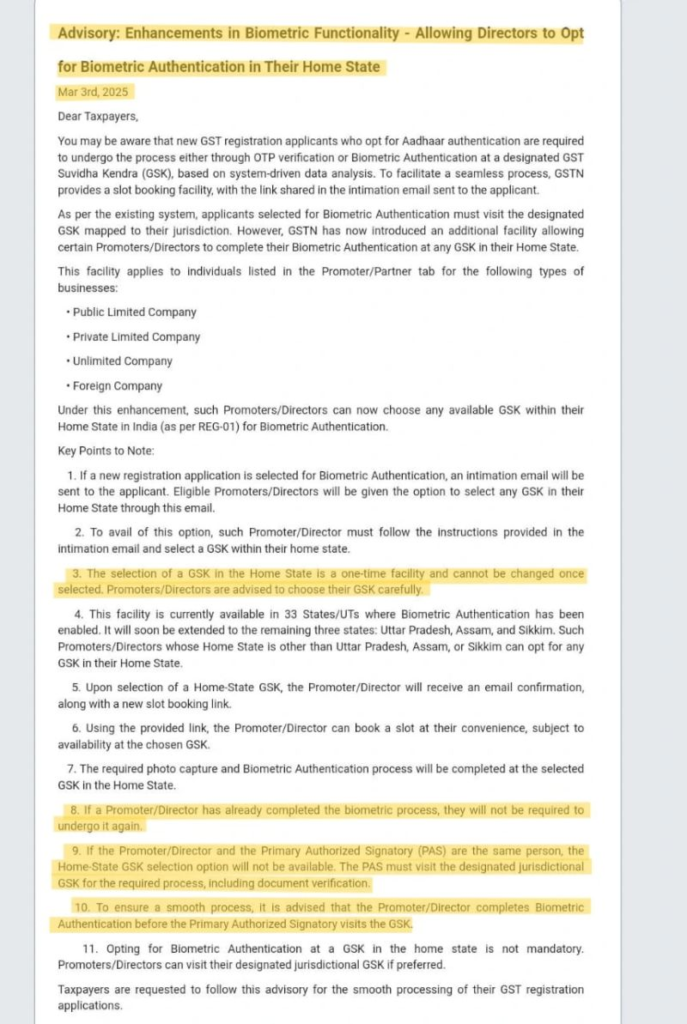
A welcome relief for businesses and corporate promoters! The Goods and Services Tax Network (GSTN) has issued an advisory dated 3rd March 2025 bringing an important improvement to the #Biometric #AadhaarAuthentication process for GST registration.

What’s the Key Relief?

Earlier, Promoters / Partners / Directors of companies often had to travel to multiple states to complete biometric Aadhaar authentication for GST registrations.

Now, only a ONE-TIME biometric authentication in the home state is required.

This change directly addresses a major operational challenge faced by many corporates operating across multiple states.

How the New Process Works

Promoters / Directors can complete one-time biometric Aadhaar authentication in their home state.
• For registrations in other states, businesses can nominate an Alternate Primary Authorized Signatory (PAS).
• The PAS will complete the biometric authentication locally in the respective state where the GST registration is being processed.

Why This Matters

✔ Eliminates repeated interstate travel for directors
✔ Reduces compliance burden and administrative delays
✔ Improves operational efficiency for multi-state businesses

📄 The advisory issued by Goods and Services Tax Network highlights important details—particularly paragraphs 3, 8, 9, and 10, which taxpayers should carefully review.

This is definitely a progressive step toward simplifying GST registration compliance.

💬 What do you think about this change? Will this make multi-state GST registrations easier for businesses?

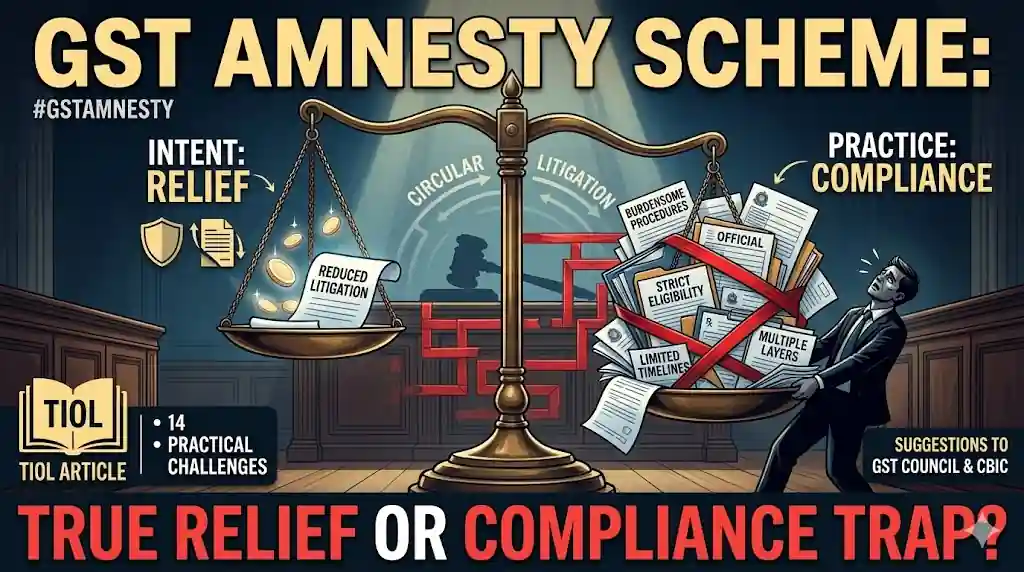
⚖️ #GSTAmnestyScheme – Relief or Another Layer of Compliance?

The #GSTAmnestyScheme was introduced with the intent to reduce litigation and provide relief to taxpayers. However, in practice, several complexities and procedural challenges continue to exist.

Instead of simplifying dispute resolution, the scheme often resembles a separate set of proceedings, involving:

• Burdensome procedural compliance
• Strict eligibility conditions
• Limited timelines
• Multiple procedural layers

As a result, taxpayers may find themselves navigating a longer and more complex compliance path, sometimes leading to circular litigation rather than true dispute resolution.

There is a strong case for the GST Council to revisit the scheme’s design and focus on:

Widening the scope of eligibility
Simplifying procedural requirements
Reducing litigation
Facilitating faster revenue realization

📄 In our article published on Taxindiaonline (TIOL), we have discussed 14 key practical challenges in the implementation of the scheme along with our suggestions to the Central Board of Indirect Taxes and Customs (CBIC) and the GST Council.

The objective is simple — make dispute settlement truly effective and practical for taxpayers.

🤝 Content supported by Akshaya Ramesh.💬 What has been your experience with the #GSTAmnestyScheme so far? Share your thoughts below.

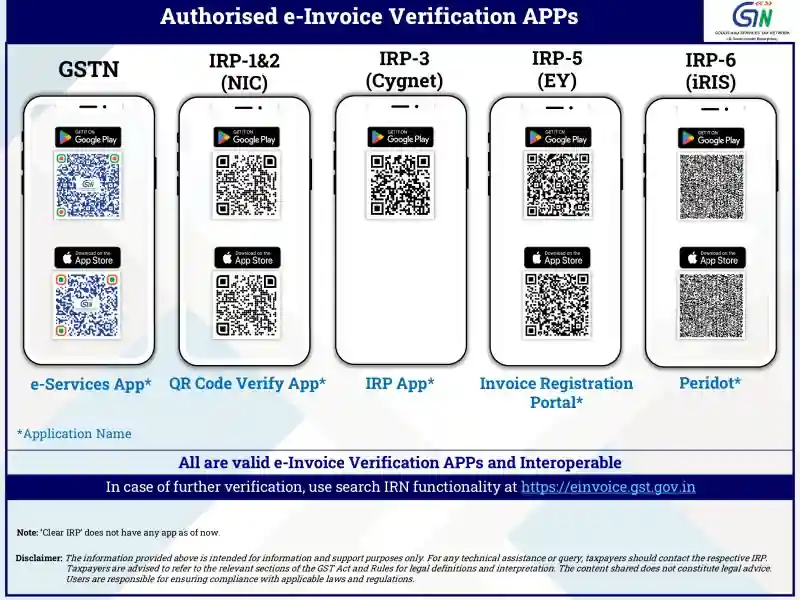
🔔 Important Update: Authorized e-Invoice Verification Apps

To make E-Invoice verification simpler and more reliable, the Goods and Services Tax Network (GSTN) has released a list of authorized B2B e-Invoice verification apps.

These apps are officially approved and help businesses securely verify e-Invoices and QR codes, ensuring smoother GST compliance.

📄 Key Points to Know:

• All listed apps are authorized by GSTN
• Apps are interoperable across the GST ecosystem
• They provide a secure and reliable way to verify e-Invoices and QR codes
• Useful for businesses to validate invoice authenticity instantly

📥 Access the full list of approved apps here:
https://lnkd.in/gae_-ubu

Stay updated. Stay compliant. 🚀

📢 CBIC Instruction No. 02/2025-GST (7th February 2025) – Any Real Relief?

The Central Board of Indirect Taxes and Customs (CBIC) has issued Instruction No. 02/2025-GST dated 7th February 2025 in relation to the waiver scheme under Section 128A.

But the big question is — is there anything significant to celebrate?
IMHO, honestly… not really.

The instruction clarifies that where Department Appeals are filed only on account of interest and/or penalty, and the taxpayer fulfills the conditions under Section 128A, the proper officer may proceed to withdraw such departmental appeals.

Fair enough… but does this really cover all practical scenarios? 🤔

Key Concerns

1️⃣ No Finality Even After Availing Waiver

Even after the waiver benefit is granted, the department is not legally barred from filing appeals or rectification against the order granting waiver.

This means that despite opting for the scheme to settle the dispute and achieve closure, the taxpayer may still face further litigation.

📌 Suggestion:
Introduce a legal provision preventing the department from appealing against orders granting waiver benefits, since proceedings should ideally conclude once Section 128A relief is granted.

Otherwise, it becomes an endless cycle of disputes.

Also, the current instruction covers only departmental appeals relating to interest and/or penalty, making it inadequate in scope.

2️⃣ No Protection from Department Appeals or Rectification

For cases relating to FY 2019-20, there is a real possibility that:

• Taxpayers may apply for amnesty and pay the tax liability, while
• The department may still file an appeal before the limitation period expires (around Feb 2025, depending on order date).

This creates uncertainty — even after opting for the amnesty scheme, taxpayers may still face departmental appeals.

📌 Suggestion:
The Central Board of Indirect Taxes and Customs should issue internal instructions to avoid departmental appeals in cases where taxpayers have opted for the amnesty scheme.

Without this, the objective of dispute settlement remains incomplete.

3️⃣ No Waiver Option for Future Uncertainty

Another practical issue arises where:

• Currently no demand exists, because the department has dropped proceedings, but
• The department may appeal against the drop order, and
• The tax liability may later be confirmed by an appellate authority.

In such situations, taxpayers lose the opportunity to opt for the amnesty scheme, because:

• There is no demand at present, and
• The law does not explicitly allow future access to the scheme if the demand arises later.

📌 Suggestion:
Amend Section 128A to allow cases where NIL demand orders are later enhanced in appeal to also qualify for the amnesty scheme.

Final Thought

While the instruction attempts to address certain procedural aspects, it falls short of providing true dispute finality.

Without stronger safeguards, taxpayers opting for the scheme may still face future appeals, rectifications, and prolonged litigation.

💬 What are your thoughts on this instruction?
Do you think the amnesty scheme achieves its intended objective of dispute resolution?

Share your views below 👇